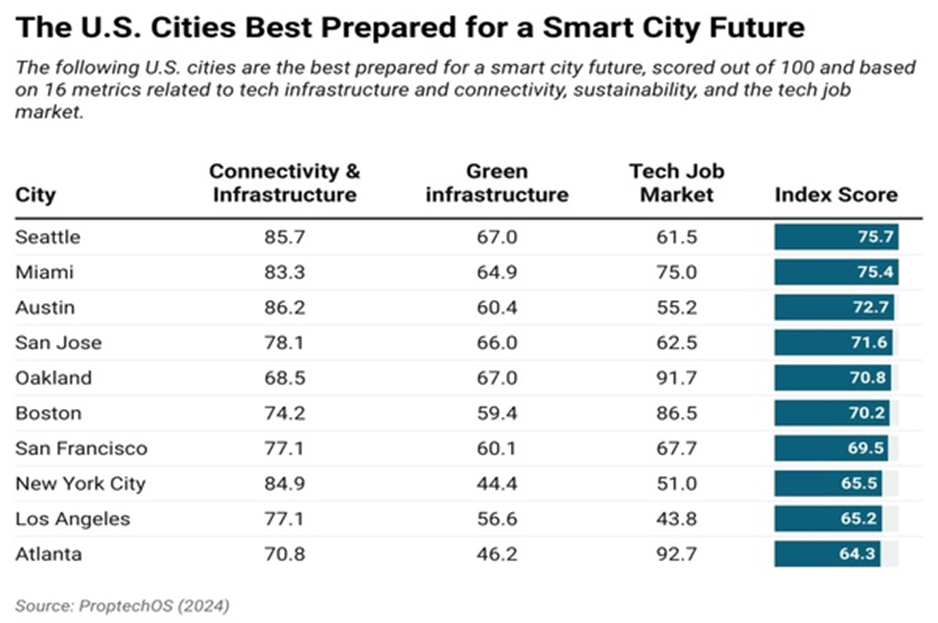
Seattle is the smartest U.S. city, an index report by ProptechOS reveals. Seattle overtook last year’s winner, Austin, Texas, to rank as the smartest city in the United States in 2024, with an overall score of 75.7 out of 100.
“Home to the likes of Amazon and Microsoft, Seattle scores highly in our research for tech infrastructure, with 34 AI companies and 13 IoT companies per 100,000 people,” the report says.
On sustainability, Seattle expanded its tree coverage by 13,700 hectares between 2010 and 2020 and built the equivalent of ten electric vehicle recharging points per 100,000 people.
To determine which cities are the smartest in 2024, ProptechOS analyzed 16 metrics related to connectivity and infrastructure, sustainability, and the tech job market. The report then ranked cities in Europe and the United States and created a weighted index.
The report analyzes three main metrics:
Tech infrastructure and connectivity, including:
The number of free WiFi hotspots
The number of AI companies
The number of AI companies per 100,000 people
The number of IoT (Internet of Things) companies
The number of IoT (Internet of Things) companies per 100,000 people
Average broadband download speeds (Mbps)
Median 5G coverage of population per network provider
The number of airports
Green infrastructure:
Air quality (exposure to PM2.5)
10-year tree loss (hectares)
10-year tree gain (hectares)
The number of electric vehicle charging points
The number of electric vehicle charging points per 100,000 people
The number of LEED-certified green buildings
The tech job market:
The number of tech jobs advertised
The number of tech jobs advertised per 100,000 people
So, what is the smartest European city? Paris!
The French capital ranks the highest in Europe among cities best prepared for a smart city future, with an overall score of 76.4, overtaking last year’s winner, London.
Paris leads with several metrics, including 99.9% 5G coverage of the population by the average network provider. It has Europe’s second-highest number (532) of AI specialist companies, and the third-highest number (10,663) of free Wi-Fi hotspots, the report says.
“Paris is also known for its smart traffic management systems, which help monitor noise levels, air quality, and other environmental factors.”
A study conducted by the maritime classification society American Bureau of Shipping this month says a green and digital shipping corridor (GDSC) between Singapore, Los Angeles and Long Beach might create more than 700 jobs in zero- and near-zero emission fuel production by 2030.
The study, commissioned by Singapore’s Maritime & Port Authority (MPA) and the ports of Los Angeles and Long Beach, also found that the corridor could also lead to health improvements for local communities, as well as economic benefits for participating countries.
The Port of Singapore’s strategic location makes it “one of the busiest and leading container trans-shipment hubs, connecting Asian markets to more than 600 ports in over 120 countries around the world,” the study says. Meanwhile, the ports of Los Angeles and Long Beach are the leading U.S. gateways for trans-Pacific trade. “The trans-Pacific trade route between Singapore and Los Angeles/ Long Beach is a “critical enabler” of the strong economic relationship between Singapore and California.
According to APEC (Asia Pacific Economic Corporation), bilateral trade reached $10.344 billion in 2022, establishing Singapore as California’s 12th-largest trading partner. Additionally, California ranks as Singapore’s second-largest trading partner among all U.S. states, representing 13.3% of the national trade in Singapore.
According to the study, the ports of Singapore, Los Angeles and Long Beach already play a “significant role in maritime decarbonization.”
MPA wants to reduce emissions from port terminals by at least 60% from 2005 levels by 2030, and to achieve net zero by 2050. “MPA also aims to reduce absolute emissions from domestic harbor craft fleet by 15% from 2021 levels by 2030, and half the emissions from 2030-level by 2050.”
Singapore is developing various net-zero fuel pathways, including focusing on electrification and biofuels for domestic harbor crafts and building up the value chain for ammonia and methanol for international shipping.
The ports of LA and LB have signed green shipping corridor agreements with ports in Asia to deploy ships with full life cycle low or even zero carbon emission capabilities in this corridor. Since the announcement of the ZEERO (Zero Emissions, Energy Resilient Operation) commitment, Long Beach has invested $300 million in establishing a green fuel hub to cut carbon emissions by 91% since 2005. In 2023, The MPA, the ports of Los Angeles and Long Beach, with the support of C40 Cities, established the Green and Digital Shipping Corridor (GDSC) to accelerate decarbonization of the maritime industry and the development and deployment of digital technology solutions and enablers
The study provides a baseline of activities and energy demand requirements for vessels operating on the corridor through 2050. The study estimates the quantity of near-zero and zero-emission fuels required for this traffic by modeling the adoption of zero and near-zero carbon alternative fuels by vessels operating on the corridor through 2050, considering various parameters such as fuel production costs and fuel availability, and in view of the targets in the 2023 International Maritime Organization’s Strategy on Reduction of Greenhouse Gas Emissions from Ships. (The study can be found at c40.me/3xF60Yw.)
“The Port of Long Beach and its partners have been very successful in reducing emissions from cargo-handling equipment, trucks and other mobile sources moving cargo in our harbor,” said Port of Long Beach CEO Mario Cordero. “One of the most important parts of this partnership is it allows us to better understand and target a source of emissions that is hard for us to control as a local seaport authority – shipborne emissions. This work, vital to our net zero-emission quest, will result in economic and health benefits all along the trans-Pacific trade corridor.”
“This study provides a sense of scale and scope to inform our implementation of the Green and Digital Shipping Corridor,” said Port of Los Angeles Executive Director Gene Seroka. “Achieving the reductions of greenhouse gas emissions required will take coordination and commitment from public and private stakeholders across the maritime and goods movement industries. We’re proud to be collaborating with industry partners to make this corridor a reality.”
A U.S. State Department fact sheet on the green corridor framework notes that green shipping corridors can “spur early and rapid adoption of fuels and technologies that, on a lifecycle basis, deliver low- and zero-emissions across the maritime sector, placing the sector on a pathway to full decarbonization.
“The United States envisions green shipping corridors as maritime routes that showcase low- and zero-emission lifecycle fuels and technologies with the ambition to achieve zero greenhouse gas emissions across all aspects of the corridor in support of sector-wide decarbonization no later than 2050.”
In a related green corridor development, X-Press Feeders, a large independent common carrier, has signed of a memorandum of understanding with six European ports: Port of Antwerp Bruges (Belgium), Port of Tallinn (Estonia), Port of Helsinki (Finland), Port of HaminaKotka (Finland), Freeport of Riga (Latvia) and Klaipeda Port (Lithuania).
Through the MOU, X-Press Feeders and the participating ports will pool resources and expertise to develop and implement sustainable practices for maritime operations.
The collaboration between the parties will begin with the establishment of these two shipping routes:
Green Baltic X-PRESS (GBX): Rotterdam – Antwerp Bruges – Klaipeda – Riga – Rotterdam
Green Finland X-PRESS (GFX): Rotterdam – Antwerp Bruges – Helsinki – Tallinn – HaminaKotka – Rotterdam
These services are scheduled to begin in the third quarter of this year. This development is significant as these will be the very first scheduled feeder routes in Europe powered by green methanol, an alternative fuel that produces at least 60% less greenhouse gas emissions than conventional marine fuel.
X-Press Feeders operates a fleet of more than 100 vessels, calling at more than 180 ports worldwide. X-Press Feeders aims to achieve net-zero emissions by 2050.
What to make of net zero? Is it really happening? Is it possible? Will there be enough money? Is there enough staying power on the part of companies and organizations? When?
One recent World Bank report, Net Zero Energy by 2060: Charting Europe and Central Asia’s Journey Toward Sustainable Energy Futures, says that with decisive action, net zero energy is within reach in Europe and Central Asia (ECA). “The World Bank has developed a model to project an optimal least-cost pathway for ECA to achieve a net zero energy target by 2060. Together, the 23 countries included in the model produce almost a tenth of global greenhouse gas emissions. The report considers the profound impact the war in Ukraine has had on energy security by representing energy trade flows on the basis of gas pipeline flows and capacities as of May 2023 and under a stress test. This novel analysis delivers insights not covered by previous works, focused mainly on the European Union.” Continuing, in the short term, “Central Asia faces a tightening gas supply balance and some difficult choices. Central Asia has been a large net exporter of gas, notably to China. Rapidly growing demand within the entire subregion, combined with stagnating production (especially in Kazakhstan and Uzbekistan), limits the ability to meet export commitments to China and peak winter demand at home simultaneously. Russia’s proposed gas union with Kazakhstan and Uzbekistan could improve Central Asia’s natural gas balance, although the poor state of pipeline infrastructure (IEA 2016) poses uncertainties. Improving regional gas trade in Central Asia and increasing gas imports from Turkmenistan could be also used to replace coal in Kazakhstan, fill the emerging supply gap in Uzbekistan, and meet growing demand across Central Asia.”
So basically, it’s time for ECA to ditch fossil fuels and embrace renewables for energy security and sustainable growth. It sounds easy enough, but it’s complicated. Very complicated
Another recent report, an article in RealClear World, says Net Zero’s days are “numbered.” Former IMF chief economist Oliver Blanchard poured water on the claim that net zero is a major growth opportunity when he told the House of Lords Economic Affairs Committee that there would be a “substantial fiscal cost to achieve anything close to Net Zero.”
Of course, it’s going to be expensive, and no one really knows how costly it will be! Is it, as some say, a growth opportunity that will pay for itself? That would be nice, but that is probably way too optimistic.
For example, a recent analysis revealed that the world is not on course to achieve the target of zero-emission fuels comprising five percent of international shipping fuels by 2030, according to Reuters. This shortfall threatens the shipping industry’s broader objective of decarbonizing by 2050. The assessment indicates that the existing production capacity for scalable zero-emission fuels (SZEF) will only cover a quarter of the required fuel volume by 2030. As of the end of 2022, there were 24 ships capable of operating on SZEF, primarily methanol, with an additional 144 on order.
However, current orders represent only one-fifth of the necessary volume to achieve mid-term sustainability goals. “It’s just not enough at scale or at the pace that is needed,” said UN COP Climate Champions shipping lead Kathryn Palmer.
And here is a wild one: An article in Fortune says, “Germany’s latest ‘net zero’ plan involves storing carbon dioxide underground beneath the sea.” Wait, what? “According to the article, Germany plans to enable underground carbon storage at offshore sites, pushing ahead with a much-discussed technology in an acknowledgment that time is running out to combat climate change,” the country’s vice chancellor said. How difficult and expensive will that be?
Yes, but what happens if the globe somehow reaches net zero? That’s a big if, of course, because there is so much work to do by companies, organizations, and governments.
A recent paper from a group of scientists, published by Frontiers in Science, “The Zero Emissions Commitment and Climate Stabilization,” has some unnerving conclusions, including this one: “How confident are we that when we stop carbon emissions, we also stop global warming?” Yikes, there’s an enigma.
Here are some “key points” in the paper:
Substantial uncertainty remains in both the sign and magnitude of the Zero Emissions Commitment (ZEC): the expected additional change in global surface temperature once we achieve net zero CO2 emissions.
Uncertainty in ZEC has implications for the remaining carbon budget to stay below the temperature limits of the Paris Agreement: a positive ZEC reduces the remaining budget; a negative ZEC opens the door for more ambitious targets or more time to reach net zero.
The prospect of additional warming after net zero is both plausible and significant, with a chance that ZEC could exceed 15% of total global warming.
While a ZEC of 0 means no further change to global surface temperatures, other aspects of the Earth system, such as sea levels, will continue to change in a net zero world due to warming realized previously. These changes should be factored into the assessment of safe warming limits and adaptation plans.
Current climate models do not adequately represent the full scope of complex and interdependent Earth system processes that determine ZEC. (bold added)
The paper presents “a structure for quantifying uncertainty in ZEC and proposes a roadmap for future research into quantifying ZEC and reducing its uncertainties.
According to a study in Nature, the planet has already passed the 1.5 °C warming threshold that climate crisis experts are saying is the goal for climate action.
At the 2015 Paris Climate Accords, nations agreed not to exceed 1.5 °C, a main guardrail of climate change. But the problem is that the planet has already passed 1.5 °C of warming, according to a new measuring technique that goes back further in time than current methods. The technique involves dating ancient sponges.
“We have an alternate record of global warming,” said coral-reef geochemist Malcolm McCulloch, at the University of West Australia Oceans Institute in Crawley, and lead author of the study. “It looks like temperatures were underestimated by about half a degree.”
However, McCulloch says that long-lived marine sponges can provide indications of temperature as far back as the eighteenth century. He and his colleagues analyzed the ratio of the elements strontium to calcium in the 300-year-old calcium carbonate skeletons of a coral-like species of sponge, Ceratoporella nicholsoni, that grows off the coasts of Puerto Rico. This ratio changes only with changes in water temperature, making it a sort of thermometer, according to the study published in Nature Climate Change.
The sponges were sampled from one particular section in the Caribbean — the only place where they are found. They were collected at a depth of 33–91 meters, in what’s called the ocean mixed layer. “Sea-surface temperature can be highly variable on top,” McCulloch was quoted as saying. “But this mixed layer represents the whole system down to a couple hundred meters, and it’s in equilibrium with the temperatures in the atmosphere.”
The sponge skeletons suggest that the planet started to warm up in the mid-1860s, during the period currently defined as the pre-industrial baseline.
“The baseline is where we measure our current temperatures from, so when we say 1.5 [degrees of warming], it’s to do with this reference point,” said McCulloch.
McCulloch and colleagues have calculated that global temperatures had in fact increased by 0.5 °C more than what was estimated by the IPCC. “That’s a huge difference relative to the total amount of warming,” says McCulloch. Furthermore, the planet exceeded 1.5 °C of warming by around 2010–2012 and is on track to surpass 2 °C in the next few years.
Climate change is all about calibration and constantly trying to catch up; our planet operates on its own time schedule, no matter how hard we try to understand.
So they decided it’s time to “transition away” from fossil fuels? It took 28 meetings for this realization?
At the end of the 28th UN Climate Change Conference (COP28), European Union and world leaders “recommitted” to delivering the Paris Agreement goals and limiting the global average temperature increase to 1.5 Celsius. They agreed to “accelerate” emission reductions towards net zero by 2050, with urgent action in this critical decade. This includes transitioning away from fossil fuels and reducing global emissions by 43% by 2030.
Some commitments and actions announced by the EU at COP28:
A Global Pledge on Renewables and Energy Efficiency to triple renewable energy capacity and double the rate of energy efficiency improvements by 2030. €2.3 billion from the EU budget will support the energy transition in the European neighborhood and around the globe
€175 million of financial support from the EU and its Member States to reduce methane emissions
More than €400 million in funding from the EU and its Member States to activate a new loss and damage fund for climate emergencies
The first two European clean tech projects to be supported by the EU-Catalyst partnership to help the EU reach its 2030 climate targets
A €20 billion Team Europe contribution to the Africa-EU Green Energy Initiative
a new Team Europe initiative focused on deforestation-free value chains
It sounds good, but…
Critics, notably activist Greta Thunberg say the deal will not prevent global temperatures from rising more than 1.5 degrees Celsius above the pre-industrial average, which scientists say will trigger catastrophic and irreversible impacts, from melting ice sheets to the collapse of ocean currents.
“This text is toothless and it is nowhere even close to being sufficient to keep us within the 1.5-degree limit,” Thunberg, 20, told Reuters outside Sweden’s parliament, where she and a handful of other protesters were calling for climate justice.
“It is a stab in the back for those most vulnerable. As long as we don’t treat the climate crisis as a crisis and as long as we keep lobby interests influencing these texts and these processes, we are not going to get anywhere,” she said.
The Conference of the Parties to the United Nations Framework Convention on Climate Change is a yearly international summit where world leaders, environmental experts, activists, and stakeholders gather to discuss and negotiate actions to combat climate change.
The 2023 United Nations Climate Change Conference or Conference of the Parties of the UNFCCC, more commonly referred to as COP28, is the 28th United Nations Climate Change conference, held from 30 November until 12 December 2023 at Expo City, Dubai.
Here’s a round-robin of takes from various publications and organizations on the status of, and chances for success, of COP 28:
Climate Home News: “Annual emissions may have just peaked but the world’s temperature will keep rising until we reach net zero. Ahead of every COP climate talks, think tanks, campaign groups and United Nations agencies get their number-crunchers to produce a load of reports summarising where the fight against climate change is at. These reports can start to induce deja vu. We’re doing some stuff to tackle climate change, usually more than the year before. But not fast enough to avoid some pretty terrifying destruction.”
“Broken record,” is the title of the UN’s latest emissions gap report. “Temperatures hit new highs yet world fails to cut emissions (again),” the subtitle.
Nature: “Is it too late to keep global warming below 1.5 °C? Chances are rapidly disappearing to limit Earth’s temperature rise to the globally agreed mark, but researchers say there are some positive signs of progress.”
Editors always told me to try to find some positives in any story. That search is getting more difficult.
The Indian Express: “Ahead of the COP 28 summit, have we lost the fight against climate change? Emissions are rising, there’s not enough money to deal with a worsening climate, and its harmful effects become more apparent every day. What’s the way ahead? Just like every previous year, the situation appears more grim, and the progress more marginal, than earlier.”
A report by Climate Analytics finds a 70% chance that emissions will peak in 2023 and start falling in 2024, mainly thanks to electric vehicles, solar and wind power.
Triple Pundit: “All in all, a multitude of complex and interconnected challenges need to be addressed at COP28 for the world to get back on track. Summit President Sultan Al Jaber emphasized in his letters to parties that ‘it is not too late to correct course’ and ‘we’re playing catch-up to keep 1.5°C alive.’ He calls for ‘optimism and unwavering resolve’ at the talks this year, though the outcome remains to be seen.”
Greenfin Weekly: “The feasibility of “keeping 1.5 alive” appears increasingly tenuous. 2023 saw the hottest month on record since 1880, and the global average temperature briefly passed 2 degrees Celsius of warming from the pre-industrial era for the first time ever in mid-November. “It will require an estimated $4 trillion annually by 2030 to transition to a clean economy that reverses those trends, and Al Jaber has noted that the money isn’t flowing fast enough.
It will take a real step change at COP28 to rewrite that equation, said Elise Larkin, director of global economic recovery at The Rockefeller Foundation.”
The way ahead is not very promising. If the private sector, especially the companies that have benefited the most from causing the climate crisis, can somehow step up and weigh-in, maybe progress will occur.
Confusion and lack of clarity abounds when it comes to implementing a carbon tax and various decarbonization proposals and goals. It’s all a game: trying to avoid costs and even making money (at least breaking even) from emission trading systems.
Decarbonization by IRENA via Flickr CC
As one knowledgeable observer noted recently, “There is little to no appetite currently among beneficial cargo owners (BCOs) to pay up for decarbonized ocean container transport. There remains a wide variance in the emission trading system (ETS) surcharge estimates by carriers that illustrates the uncertainty over just how much the carbon tax will cost the industry.”
As Greg Knowler, Europe Editor at IHS Markit Maritime & Trade, relates in a LinkedIn post, Ocean carriers will need to comply with the European Union emissions trading system (ETS) from Jan. 1, 2024, a cap-and-trade principle that has been applied to industries in Europe since 2005 and was recently extended to cover shipping. His article continues:
“A cap is placed on the amount of CO2 that can be emitted by those within the system and companies must buy carbon allowances that cover their annual emissions. These allowances can be bought on the open carbon market or traded among companies.
“From Jan. 1, for every ton of CO2 emitted by a ship, the carrier will need to buy 1 emission allowance, called an EUA, from the carbon market. The regulation will be phased in according to a progressive schedule over the next two years. In 2024, carriers will be charged for 40% of all emissions, 70% in 2025 and 100% of emissions after 2026.
“Half of journeys that begin or end outside the EU will be covered by the ETS, and all the emissions from voyages between ports in the EU and while alongside will be covered.
“There are significant costs involved for carriers. According to emissions monitoring platform OceanScore, the maritime industry in 2022 generated CO2 emissions of 126 million tonnes from voyages to, from, between and within European ports. That would have resulted in the need to surrender 82.7 million EU Allowances (EUAs), or carbon credits, under the ETS, equating to a total cost of €6.5 billion based on the current price of €78 per EUA.
“Hapag-Lloyd CEO Rolf Habben Jansen has estimated the ETS will cost Hapag-Lloyd $100 million in 2024, with that amount tripling in the next couple of years, and he has vowed to recover those costs from customers.”
Knowler quotes Jansen: “The initial cost is there, and we will not absorb the cost, It is real and is a fully out-of-pocket cost and people must accept it. We talk about $100 extra per container, and if you look at the value of the goods that are inside, people should be able to accept that.”
Knowler writes, “It will become harder and harder for the carriers to absorb the ETS costs as they get phased in, and as the free emission allowances across all industries gets phased out and compliance gets progressively more expensive…this is the way the system has been designed. The ETS is supposed to make it more expensive so those in the shipping industry are forced to use greener fuels and services to enable the European Union to be climate neutral by 2050.”
That last concluding bit is the point of this complicated and ultimately frustrating exercise. The bottom line is that no one wants to pay for the cost of climate change except those that can’t afford it. Climate change will exact its own high costs for everyone on this planet sooner or later.
The thing about net zero emissions and decarbonization is that while intentions are well meaning (or not) companies, especially those that use fossil fuels, don’t want to pay. God forbid that their margins and profits might decrease if they implement net zero net zero actions. Better to protect shareholders than the climate. It’s disgusting, shortsighted, and deadly,
This is the real bottom line: Do the right thing. Take the financial hit for the good of the planet! You can afford it!
The grants will help Washington communities build and update charging infrastructure for EVs.
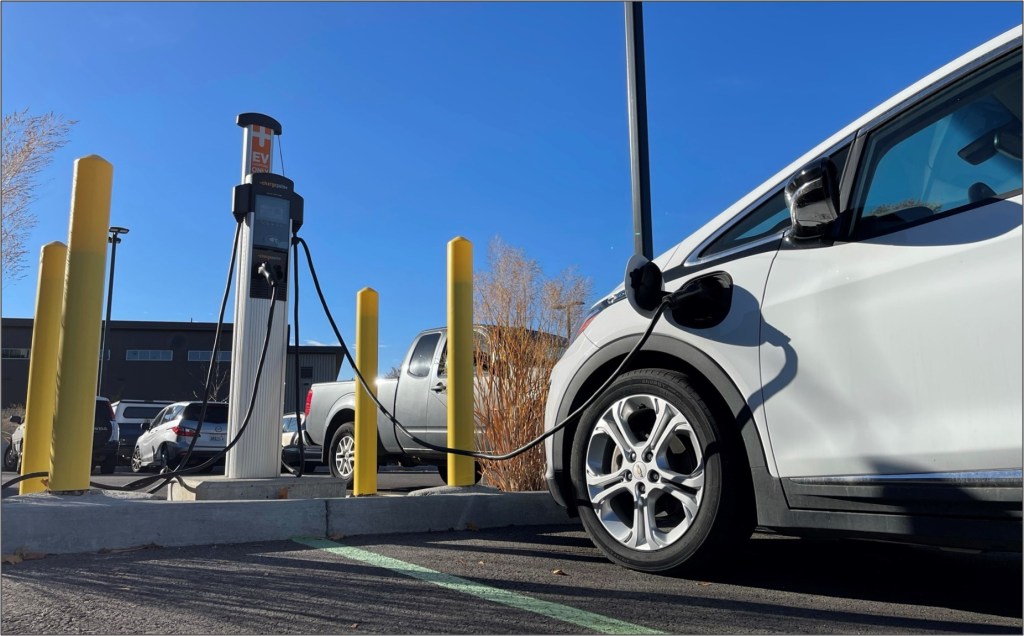
The Washington Department of Ecology is offering $3.5 million in grants over the next two years to purchase and install Level 2 charging stations and upgrade existing charging stations in public, fleet, workplace, and residential locations.
Washington businesses, Tribes, nonprofits, public entities, and multi-family residences are eligible to apply for the electric vehicle (EV) charging infrastructure grants.
The so-called “Charge Where You Are” grants are intended to attract applicants from a wide range of community groups over multiple funding rounds. The department says the first installment will distribute $1 million, with priority given to projects in rural areas, as well as neighborhoods with limited access to EV charging and communities that are disproportionately affected by air pollution. Funding for the grants comes from Washington’s Volkswagen diesel emissions settlement. Applications for the first round are open now through Nov. 16.
“Not everyone lives where they can charge an EV in their garage every night,” said Molly Spiller, manager of the Pollution Reduction Grants Section in Ecology’s Air Quality Program. “By making more charging stations available in apartments, multi-family homes, workplaces, and public locations, such as parks and libraries, we can help make EV ownership a reality for more drivers.”
With a 240-volt output, Level 2 chargers are commonly used in offices and public spaces. Although slower than the fast chargers found along highways and major road corridors, they can recharge most EVs in 4 to 10 hours.
Kathy Taylor, Air Quality Program manager, says, “We estimate the Level 2 projects we fund will help reduce greenhouse gas emissions by about 2,200 tons per year.”
Ecology anticipates opening additional grants for faster, direct current (DC) EV charging stations in 2024.
The creation of the first green shipping corridor across the Pacific is taking shape.
Credit: U.S. Naval Institute/Shutterstock
Last week a voluntary partnership of maritime goods movement stakeholders, including the Ports of Los Angeles, Long Beach and Shanghai, some of the largest carriers in the world, and key leading cargo owners unveiled a Green Shipping Corridor Implementation Plan Outline designed to accelerate emissions reductions on one of the world’s busiest container shipping routes across the Pacific Ocean.
The plan, the first of its kind, was developed with support from C40 Cities as part of their effort to reduce carbon emissions from the largest cities in the world.
A joint press release from the stakeholders says the plan “is an important step toward decarbonizing the global supply chains that power our economies and transitioning toward zero lifecycle carbon emission ships.” In addition, it will showcase “cutting-edge goods movement technologies, decarbonization applications and best management practices to enhance efficiency, and catalyze technological, economic and policy efforts to progressively decarbonize shipping and port-related activities.”
Carrier partners will begin deploying reduced or zero lifecycle carbon capable ships on the corridor by 2025, and work together to demonstrate by 2030 the feasibility of deploying the world’s first zero lifecycle carbon emission container ship(s).
Carrier partners include CMA CGM, COSCO Shipping Lines Co., Ltd., Maersk, and ONE. Core partners include the Shanghai International Port (Group) Co., Ltd., the China Classification Society, and the Maritime Technology Cooperation Centre of Asia.
Partnership participants will take steps to reduce carbon emissions and harmful pollutant emissions impacting air quality, through methods such as expanding the use of shore power and supporting the development of clean marine fueling infrastructure. Cargo owner partners have set goals to contract with carriers to use zero lifecycle carbon emission shipping services, and in an effort to measure progress toward decarbonization, all partners will develop metrics to track decarbonization progress.
Gene Seroka, Executive Director of the Port of Los Angeles, said, “This trans-Pacific green corridor will be a model for the global cooperation needed to accelerate change throughout the maritime industry. Most of the emissions associated with moving cargo by ship occur in the mid-ocean part of the journey between ports. This corridor will help reduce mid-ocean emissions while continuing the work we have done to cut emissions within our ports.”
The initiative will drive emissions reductions across the world’s largest ocean and lead to greener practices from supply chain participants along these vital trade routes, added Mario Cordero, Chief Executive Officer of the Port of Long Beach. “The new and innovative vessel technologies, increased availability of sustainable fuels and better practices created through this green corridor will also impact society’s transition to a cleaner future far beyond the areas served by our ports.”
C40 Cities is a network of world cities that are working to deliver the urgent action needed “to confront the climate crisis and create a future where everyone, everywhere can thrive.” Mayors of C40 cities are committed to using a science-based and people-focused approach to help the world limit global heating to 1.5°C and build healthy, equitable and resilient communities. Through a Global Green New Deal, mayors are working alongside a broad coalition of representatives from labor, business, the youth climate movement and civil society to go further and faster than ever before.
Established in 2004, Shanghai Municipal Transportation Commission (SMTC) undertakes the management and safety supervision of the highways and urban roads, road transportation and urban traffic, ports and shipping, and other transportation industries in Shanghai. SMTC also leads the development of the Shanghai International Shipping Center. SMTC coordinates the air, rail and postal transportation management. SMTC aims to optimize the layout of the transport structure, comprehensively balance the transport capacity, and build an integrated transportation system in Shanghai.
The California State Transportation Agency (CalSTA) this month announced $1.5 billion in grants as part of efforts to build a “more efficient, sustainable and resilient supply chain.” The program includes approximately $450 million for zero-emission infrastructure, locomotives, vessels and vehicles.
Port of Long Beach CA by Ken Harrell via Flickr CC
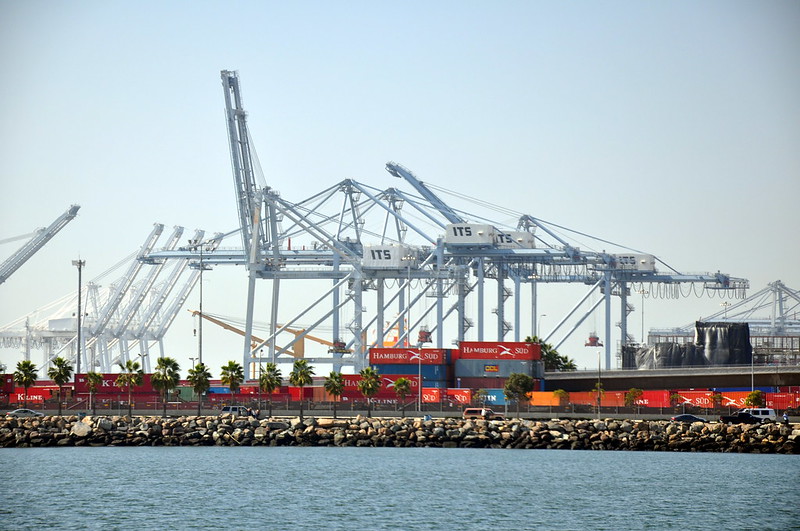
A major chunk of the funding includes a $383.35 million grant for the Port of Long Beach to complete a series of construction and clean-air technology projects to “accelerate” the transformation to zero-emissions operations and enhance the reliability and efficiency of cargo movement.
Also, as part of the state’s Port and Freight Infrastructure Program, nearly $225 million will fund a variety of zero-emissions cargo-moving equipment and support infrastructure projects across the Port of Long Beach, including “top handlers” and other manually operated cargo-handling equipment, as well as tugboats and locomotives. The sum is the single largest grant the port has received to support the zero-emissions goals of the 2017 Clean Air Action Plan Update.
The Port of Los Angeles will receive $233 million in grants from the state to complete infrastructure projects aimed at creating a more efficient and sustainable supply chain. “This nearly quarter-billion-dollar investment in critical Port of Los Angeles projects –– along with an additional $191 million in supporting regional projects –– will accelerate our efforts to boost competitiveness, create jobs and enhance decarbonization efforts,” said Port of Los Angeles Executive Director Gene Seroka.
The Port of Oakland was awarded $119 million in grant funding from the state under the Port Freight Infrastructure Program (PFIP). The funding will support infrastructure improvements at the port’s maritime facilities and roadways, and to electrify port cargo handling equipment.
A complete list of projects is available at the following links:
The funding – particularly the investments in zero-emission projects, which account for nearly 40 percent of the Port and Freight Infrastructure Program awards – builds on a partnership between the governments of California and Japan announced in March to collaborate on strategies to cut planet-warming pollution at seaports and establish green shipping corridors as part of the state’s broader strategy to aggressively combat and adapt to climate change.
The investments also follow the California Transportation Commission’s recent approval of $1.1 billion for infrastructure improvements on high-volume freight corridors as part of the Trade Corridor Enhancement Program (TCEP) – for a total state investment in supply chain infrastructure of more than $2.6 billion this month.








 wrdforwrd