California Grants Target Big Bucks for Net-Zero Efforts

The California State Transportation Agency (CalSTA) this month announced $1.5 billion in grants as part of efforts to build a “more efficient, sustainable and resilient supply chain.” The program includes approximately $450 million for zero-emission infrastructure, locomotives, vessels and vehicles.
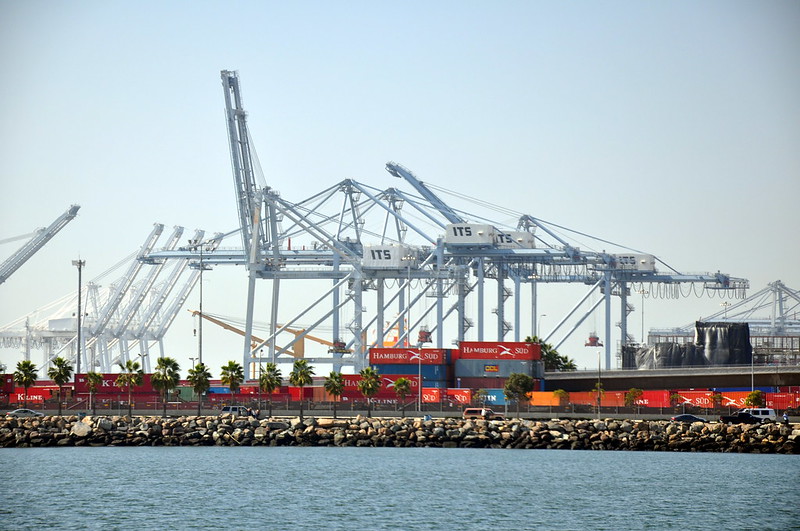
Port of Long Beach CA by Ken Harrell via Flickr CC

A major chunk of the funding includes a $383.35 million grant for the Port of Long Beach to complete a series of construction and clean-air technology projects to “accelerate” the transformation to zero-emissions operations and enhance the reliability and efficiency of cargo movement.

Also, as part of the state’s Port and Freight Infrastructure Program, nearly $225 million will fund a variety of zero-emissions cargo-moving equipment and support infrastructure projects across the Port of Long Beach, including “top handlers” and other manually operated cargo-handling equipment, as well as tugboats and locomotives. The sum is the single largest grant the port has received to support the zero-emissions goals of the 2017 Clean Air Action Plan Update.

The Port of Los Angeles will receive $233 million in grants from the state to complete infrastructure projects aimed at creating a more efficient and sustainable supply chain. “This nearly quarter-billion-dollar investment in critical Port of Los Angeles projects –– along with an additional $191 million in supporting regional projects –– will accelerate our efforts to boost competitiveness, create jobs and enhance decarbonization efforts,” said Port of Los Angeles Executive Director Gene Seroka. 

The Port of Oakland was awarded $119 million in grant funding from the state under the Port Freight Infrastructure Program (PFIP). The funding will support infrastructure improvements at the port’s maritime facilities and roadways, and to electrify port cargo handling equipment. 

A complete list of projects is available at the following links:

The funding – particularly the investments in zero-emission projects, which account for nearly 40 percent of the Port and Freight Infrastructure Program awards – builds on a partnership between the governments of California and Japan announced in March to collaborate on strategies to cut planet-warming pollution at seaports and establish green shipping corridors as part of the state’s broader strategy to aggressively combat and adapt to climate change.

The investments also follow the California Transportation Commission’s recent approval of $1.1 billion for infrastructure improvements on high-volume freight corridors as part of the Trade Corridor Enhancement Program (TCEP) – for a total state investment in supply chain infrastructure of more than $2.6 billion this month.
Green Corridors on the deep blue sea

On the shipping lane by Kari Nousianien via Flickr CC

The ports of Gothenburg and Rotterdam pledged to establish a Green Corridor between the two cities, which will put a framework in place for collaboration on alternative fuels and reducing carbon emissions.

The Memorandum of Understanding (MoU) was signed in the presence of the Swedish and Dutch royal families. It is intended that the corridor will become part of the European Green Corridors Network, set up in March 2022 by the Maersk McKinney Moller Centre for Zero-Carbon Shipping.

According to a recent report from McKinsey, zero-emission fuels and vessels will need to be deployed over the next decade to achieve full decarbonization of the shipping sector by 2050. “This ambitious goal could be catalyzed by green corridors.”

The zero-emission goal was established by the International Maritime Organization (IMO), which has mandated emission reductions of 50 percent for all vessels by 2050. (Annex 11 Resolution MEPC.304(72) adopted April 13, 2018, Initial IMO strategy on reduction of GHG emissions from ships, International Maritime Organization, imo.org.) A number of countries—including Japan, the United Kingdom, and the United States—have declared a target for net-zero shipping emissions in the same time frame.

The U.S. Department of State released a “Green Shipping Corridors Framework” fact sheet in April that states: “Green shipping corridors can spur early and rapid adoption of fuels and technologies that, on a lifecycle basis, deliver low- and zero-emissions across the maritime sector, placing the sector on a pathway to full decarbonization. The United States envisions green shipping corridors as maritime routes that showcase low- and zero-emission lifecycle fuels and technologies with the ambition to achieve zero greenhouse gas emissions across all aspects of the corridor in support of sector-wide decarbonization no later than 2050. There are multiple pathways through which a fully decarbonized corridor can be achieved; this green shipping corridors framework therefore provides maritime stakeholders the flexibility to choose the path that best suits their needs.”

It seems that we are in the early stages of actually establishing green corridors in the maritime/port sector, which is why the Rotterdam-Gothenburg agreement is significant. Allard Castelein, Chief Executive of the Port of Rotterdam said: “This Green Corridor initiative is part of our ongoing efforts to bring together parties across the supply chain to help realize more sustainable shipping in support of the Paris Agreement.” And Elvir Dzanic, Chief Executive of the Gothenburg Port Authority added: “We can now present a more distinct path towards the decarbonization of shipping.”

The McKinsey report asserted: “Finding industry-wide solutions is challenging, given the varied and complex nature of the sector. One way to accelerate decarbonization is to implement ‘green corridors’: specific trade routes between major port hubs where zero-emission solutions are supported. A new report, The next wave: Green corridors, produced by the Getting to Zero Coalition in collaboration with the Global Maritime Forum, Mission Possible Partnership, and Energy Transitions Commission, with analytical support from McKinsey, probes the feasibility of two such selected corridors,” the Australia-Japan iron-ore route and the Asia-Europe container route.

The results of this analysis are “encouraging” but there is still a long navigation ahead.