
There’s an effort underway in the Pacific Northwest to make freight and cruise waterways as green as possible.
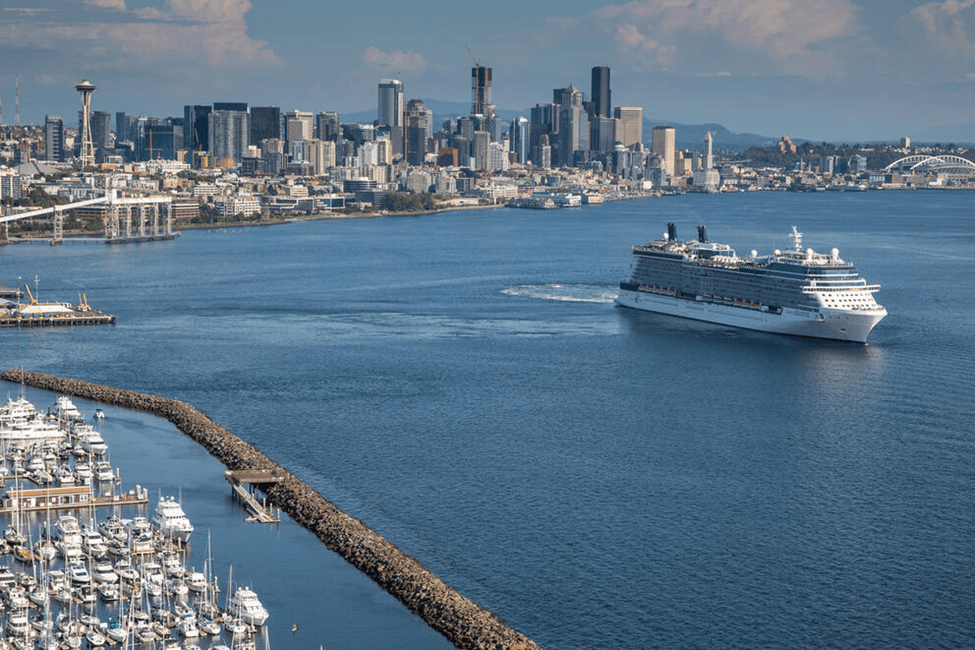
The Royal Caribbean Ovation of the Seas cruise ship leaves a port near Seattle. (Courtesy of the Port of Seattle)
Actually, the Green Corridor concept has been underway for some time.
Last May, the Pacific Coast Business Times reported the Port of Hueneme became the first U.S. port authority to sign agreements to create green automotive shipping corridors with ports and terminals in Japan and South Korea. “The partnerships we have with Japan and South Korea will help mutually grow commercial relationships with existing port clients and allow for a dynamic effort to make a difference around the globe with green shipping and development practices,” Kristin Decas, Port of Hueneme CEO and director, said in a press release.
The Port of Hueneme signed agreements to create green automotive shipping corridors between it and the Port of Yokohama in Japan and the Wallenius Wilhelmsen Pyeongtaek International Ro-Ro automotive terminal in the Port of Pyeongtaek, South Korea.
The agreements will help promote collaboration for environmentally sustainable port development initiatives and automotive logistics to transition to a zero-emission future, according to the release.
In September 2023, the Ports of Los Angeles, Long Beach, and Shanghai unveiled an Implementation Plan Outline for the first trans-Pacific green shipping corridor. Corridor features include:
- A voluntary partnership of leading maritime goods movement stakeholders, including the Ports of Los Angeles, Long Beach, and Shanghai, with input from leading cargo owners, has developed a Green Shipping Corridor Implementation Plan Outline to accelerate emissions reductions on one of the world’s busiest container shipping routes.
- Plan development was supported by C40 Cities, the global network of mayors working to deliver the urgent action needed to confront the climate crisis. C40 is the facilitator of the Green Shipping Corridor, providing support to the cities, ports, and their corridor partners by coordinating, convening, facilitating, and providing communications support for the corridor’s goals.
- Carrier partners supporting this plan intend to begin deploying reduced or zero lifecycle carbon capable ships on the corridor by 2025.
X-Press Feeders, the world’s largest independent common carrier, recently signed a memorandum of understanding (MOU) with six European ports: Port of Antwerp Bruges (Belgium), Port of Tallinn (Estonia), Port of Helsinki (Finland), Port of Hamina Kotka (Finland), Freeport of Riga (Latvia) and Klaipeda Port (Lithuania).
Through this MOU, X-Press Feeders and the participating ports will pool resources and expertise to develop and implement sustainable practices for maritime operations.
Under the MOU:
– Parties will work together to further develop infrastructure for the provision and bunkering of alternative fuels such as green methanol,
– Encourage the development of supply chains for fuel that are zero or near zero in terms of greenhouse gas emissions
– Provide further training programs for port workers and seafarers with regards to the handling of alternative fuels
– Leverage digital platforms to enhance port call optimization
– Parties will have regular meetings to update and discuss progress on actions for further developing green shipping corridors.
X-Press Feeders’ green methanol is sourced from fuel supplier OCI Global. The green methanol is made from green hydrogen and the decomposition of organic matter, such as waste and residues. OCI’s green methanol is independently certified by the International Sustainability and Carbon Certification (ISCC) Association headquartered in Germany. The ISCC system promotes and verifies the sustainable production of biomass, circular and bio-based materials and renewables.
X-Press Feeders, which was founded in Singapore in 1972, is the world’s largest independent common carrier. X-Press Feeders operates a fleet of more than 100 vessels, calling at more than 180 ports worldwide. X-Press Feeders aims to achieve net zero emission by 2050 and be the ‘Greener Feeder Carrier of Choice’.
Green Shipping
Green shipping refers to transporting goods with as little environmental impact as possible. This may involve using advanced technology to optimize ship design, operations and performance to improve energy and fuel efficiency, prevent pollution, and reduce emissions. The concept of green shipping may be implemented already in the design phase of a new vessel, through continuous improvements or by switching to zero-emission fuels.
Switching to zero-emission fuels is gradually proceeding as more alternative fuels and engines enter the market. More shipbuilders are designing ships with green technology such as dual-fuel engines to accelerate the shift to clean fuels
Green shipping also includes training and educating staff and crew members in marine environmental awareness, including environmental policies, global requirements and compliances, ship energy efficiency, safe bunkering, oil transfer procedures, pollution prevention, garbage handling and disposal, biofouling, and ballast water management.
The International Maritime Organization (IMO) has set a target to reduce the total annual GHG emissions from international shipping by at least 50 percent by 2050.
So, here’s the skinny on the latest green corridor, from the Port of Seattle.
The Pacific Northwest to Alaska Green Corridor (PNW2Alaska) is a collaboration among 14 organizations to create “a new era of low- and zero- greenhouse gas (GHG) emission cruise travel between Alaska, British Columbia and Washington.”
Decarbonizing this environmentally sensitive route is challenging, the port says. “Urban ports like Seattle and Vancouver can access large amounts of clean electricity to run shoreside operations and may have easier access to alternative fuels being developed. Smaller, remote ports in Alaska have more infrastructure and access challenges. Any decarbonization solution needs to work for cities, boroughs, ports, and cruise lines carrying passengers thousands of miles.”
The PNW2Alaska Green Corridor initiative considers the needs of each partner as it tests the feasibility of local solutions to decarbonize cruises in the Pacific Northwest. “One goal for all partners is that this first cruise-led Green Corridor can be an idea test bed that accelerates decarbonization at the 2,000 river and ocean cruise ports around the world.”

An aerial view of ships, boats, ferries and liners around Vancouver, B.C. (Courtesy of Vancouver Fraser Port Authority)
“No single group can achieve decarbonization. Combatting the reality of climate change takes honesty, accountability, innovation, and partnership,” said Port of Seattle Commission President Hamdi Mohamed of the collaboration. “We want to become a zero-emission port by 2050, and we need communities and industry partners to work together to meet these ambitious goals.”
PNW2Alaska was established in response to the 2021 Clydebank Declaration, a global commitment to create six green corridors on specific shipping routes by 2025, with corridors in operation by 2030, to move the needle toward maritime decarbonization at scale. Twenty-four countries took the commitment, the U.S. and Canada among them.
Next, Green Corridors, Part 2, and “elevating the future of freight.”

 wrdforwrd