Economic impact report says Seattle, Tacoma, bring nearly $55 billion to PNW

A new regional economic impact analysis shows The Northwest Seaport Alliance (NWSA), the Port of Tacoma, and the Port of Seattle continue as the primary drivers of the regional and state economy.  They supported more than 265,000 jobs in 2023, and together, the organizations generated $17.7 billion in wages and benefits and nearly $55 billion in business output.

The report offers a comprehensive regional look across the Seattle-Tacoma gateway, including marine cargo, aviation, real estate, commercial fishing, and the cruise industry. This is the first time that all lines of business have been evaluated together, according to the report.

It includes an analysis of direct jobs — such as longshore workers, truck drivers, and airport employees — as well as capturing a comprehensive viw of indirect jobs and induced economic benefit. Together, these represent the collective impact of port activities, demonstrating the amplifying economic effect the three organizations have across the region.  In addition, the organizations helped generate nearly $550 million in state tax revenues in 2023 (Exhibit 90). Jobs

The Northwest Seaport Alliance

The Northwest Seaport Alliance (NWSA) manages marine cargo in both harbors and in 2023 handled nearly 3 million twenty-foot equivalent units (TEUs) of containerized cargo, making it one of the largest gateways in the United States. Further, the NWSA is a key gateway for auto imports and breakbulk cargo. In 2023, NWSA operations supported an estimated 52,100 jobs, including 18,000 direct jobs, $4.4 billion in total wages and benefits, and nearly $14 billion in total business output throughout the state of Washington. 

Port of Tacoma

The report found the combined impact of trade through the NWSA’s South Harbor and additional Port of Tacoma lines of business in 2023 supported more than 41,000 jobs, $3.4 billion in wages and benefits, and a business output of almost $10.8 billion.

“We often talk about Washington being the most trade dependent state in the nation. What we don’t always talk about is how the trade that comes through our gateway is the catalyst for a robust supply chain ecosystem and quality living wage jobs across the state. We aren’t just dependent on trade, we excel at it,” said Northwest Seaport Alliance Co-Chair and Port of Tacoma Commission President John McCarthy in a press release.. “That trade excellence also serves the rest of the country. We are the ports of Idaho farmers and Midwest consumers; we serve a role of national importance and impact.”

Port of Seattle

The Port of Seattle’s business lines supported almost $39 billion in total business output, over 205,000 total jobs, and $396 million in total fiscal impact to the state.

The largest line of Port of Seattle business in the region is Seattle-Tacoma International Airport (SEA), which supported nearly 175,000 jobs in 2023, $10.5 billion in wages and benefits, and $33.3 billion in business output.

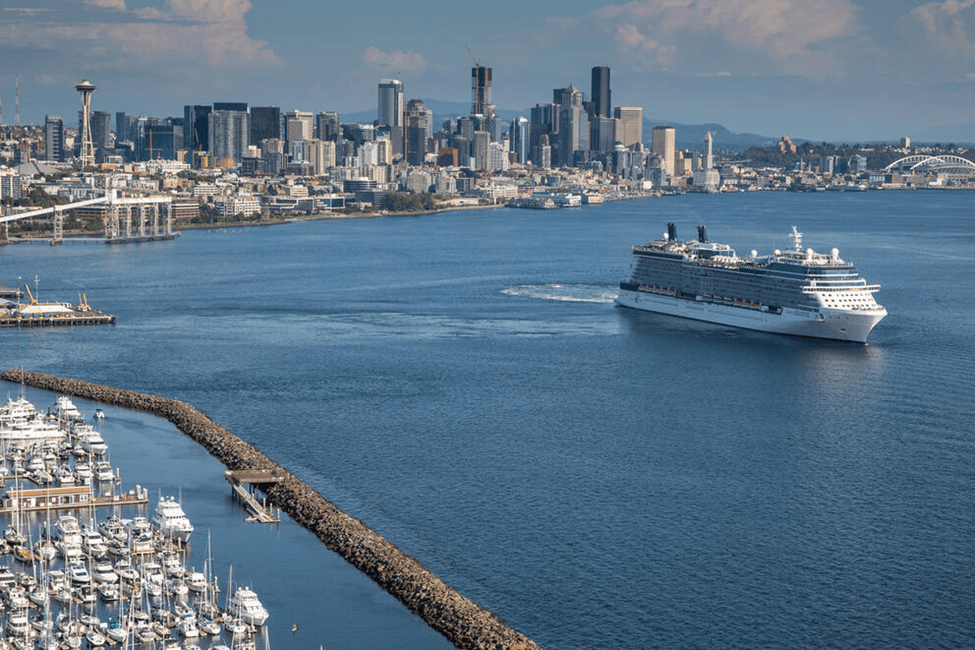
The Port of Seattle’s growing cruise business is expected to support 5,120 jobs in 2025, generating nearly $327 million in wages and benefits and over $1.2 billion in business output.

The report also found the Port of Seattle’s commercial fishing industry supported 8,790 jobs in 2023 and generated $484 million in wages and benefits and over $1 billion in business output. The Port of Seattle’s other lines of business, including its real estate, maritime moorage, and recreational boating portfolios supported an additional 16,035 jobs in 2023, nearly $1.3 billion in wages and benefits, and just under $3.3 billion in business output.

“At the Port of Seattle, we’re building the port of the future ‒ one that drives economic opportunity, safeguards family-wage jobs, and advances environmental stewardship,” said Northwest Seaport Alliance Co-Chair and Port of Seattle Commission President Toshiko Hasegawa. “This report reaffirms that our marine cargo and aviation gateways are vital to the economic health of our region. And just as important, it reflects the strength of our decade-long collaboration between the Ports of Seattle and Tacoma through The Northwest Seaport Alliance ‒ proving what’s possible when we come together with a shared vision for sustainable, inclusive growth.”

The report, prepared by Community Attributes, Inc., measures jobs, income, and business output directly supported by port activities, as well as associated nearby services tied to port operations (such as warehousing and off-site transloading) and the broader economic and fiscal impacts of these activities to the state economy.

Download the full Economic Impact Analysis (PDF)

Contact

Katherine Fountain | Senior Media Officer
(206) 787-3071 | fountain.k@portseattle.org

UN Guide will help insurers plan for net-zero transition

Solar on net-zero house. Credit: David Dodge, Green Energy Futures via Flickr CC

The United Nations published a guide designed to help insurers plan for the transition to net zero.

On 2 July, the UN convened a multistakeholder “Forum for Insurance Transition to Net Zero (FIT)”, saying the guide is tailored for insurance and reinsurance underwriting portfolios. “This new deep-dive global guide was presented at the inaugural FIT Transition Insurance Summit hosted by the European Insurance and Occupational Pensions Authority (EIOPA) at their headquarters in Frankfurt, Germany.”

According to a Green Central Banking article, “The impact of climate change on insurance markets has been systematically underestimated, with profound implications for financial stability and the sustainability of the risk-sharing services insurance companies provide.

“The European Central Bank warned in June that insurers are at increasing risk from the physical risks of climate change, which could become a source of systemic risk.”

The UN described FIT as follows: “Underwriting the Transition” provides insurance market participants—insurers, reinsurers and brokers—with a comprehensive and structured framework to help them develop and disclose credible transition plans for underwriting portfolios, addressing a significant gap in existing transition plan guidance for the insurance industry.

“This pioneering guide paves the way for insurers, reinsurers and brokers to move beyond high-level commitments by independently implementing robust and actionable strategies that enhance long-term business resilience and company value, and help achieve global sustainability goals,” said Butch Bacani, UNEP Head of Insurance and FIT Chair. By underwriting with foresight, and by accelerating and scaling up a just transition to a resilient net-zero economy, the insurance industry can lead with purpose and conviction in helping build inclusive, resilient and sustainable communities and economies, and reaffirm its role as society’s risk manager.”

“Underwriting the Transition identifies key elements of a credible transition plan and provides a checklist to assess the credibility of a transition plan. Through real-world examples, the guide demonstrates how leading insurers, reinsurers and brokers are each implementing various concepts and approaches in their underwriting portfolios that support a just transition to a resilient net-zero economy, as shared in their published transition plans. Moreover, it helps insurance market participants navigate a complex and evolving landscape of sustainability disclosure and reporting.

“It is the second deliverable of the FIT Transition Plan Project—a series of global guidance to address the current major gap in insurance-specific transition plan guidance. “Underwriting the Transition” builds on the FIT’s inaugural report, “Closing the Gap: The emerging global agenda of transition plans and the need for insurance-specific guidance”, which was launched at the 2024 UN Climate Conference (COP29) in Baku, Azerbaijan.”

The third and final FIT Transition Plan Project publication will produce holistic, “total balance sheet” transition plan guidance that links the underwriting and investment portfolios of insurance and reinsurance companies. It is scheduled to be launched at the 2025 UN Climate Conference (COP30) in Belém, Brazil this November.

At the COP29 launch event of the FIT’s inaugural report, Dyogo Oliveira, President of the Brazilian Insurance Confederation (CNseg), announced that CNseg has joined the FIT, and that CNseg will build a “House of Insurance” at COP30, which will serve as the main platform for climate ambition and action by the global insurance industry.

“As COP30 approaches, we look forward to working together with the Brazilian insurance industry, the wider insurance, regulatory and supervisory community, and key stakeholders—from policymakers and real economy actors; to the scientific and academic community, and civil society—and to making the ‘House of Insurance’ a symbol of inclusiveness, resilience, sustainability, and hope,” said Bacani.

Chaired by the United Nations Environment Programme (UNEP), the FIT currently comprises over 50 organizations from across the globe.

UNEP saif FIT “continues to deepen and strengthen its commitment to work with the global insurance industry and key stakeholders to support the acceleration and scaling up of a just transition to a resilient net-zero economy as part of the solution to the triple planetary crisis of climate change, nature loss, and pollution; and the vision of a resilient, sustainable, and prosperous future for all.”

Related recent climate change reading:
Reuters: World risks up to $39 trillion in economic losses from vanishing wetlands, report says  
World Economic Forum: Why we must roll out multiple energy transition solutions to reach net zero. https://www.weforum.org/stories/2025/07/multiple-energy-transition-solutions-to-hit-net-zero/   The Guardian: Politicians are retreating from net zero because they think the public doesn’t care. But they’re wrong.  https://www.theguardian.com/commentisfree/2025/jul/07/politicians-net-zero-public-research-climate-crisis  Rebecca Willis  
 

A world without birds?

Sulphur Crested Cokatoo by Bernard via Flickr CC

Unimaginable…but a Clemson University study concludes that climate is changing faster than most of the world’s birds can adapt.

Casey Youngflesh, an assistant professor in Clemson University’s Department of Biological Sciences, led a study at the university that examined how a bird’s pace of life — the rate at which it grows, develops, reproduces, and how long it lives — is related to environmental conditions and what that reveals about how they might respond to a changing climate.

Included in the study were 7,477 species of birds — basically all the world’s resident, non-marine birds — and used global climate data from 1950 to 2022.

Youngflesh and collaborators from Michigan State University “found that a key link exists between how much an environment varies over time and how long birds tend to live,” according to an article by Cindy Landrum of Clemson’s College of Sciences. “Specifically, species tend to live longer in environments that are more variable from year-to-year, a type of bet-hedging strategy that has long been theorized.”

These longer-lived species “may be at greater risk as well. All else being equal, these species experience greater change per generation than their shorter-lived counterparts. Because more generations means faster adaptation potential, these species are more likely to lag behind in their response to climate change.”

“One of the key things that varies among different bird species is pace of life. We were specifically interested in the role of the environment in potentially driving those differences,” Youngflesh said. “Where do we see ‘slow species’? Where do we see ‘fast species’? And why?”

The study found that birds with a “fast” pace of life have shorter lifespans and have as many young as they can during that time, something Youngflesh called a “live fast, die young” strategy. Birds with a “slow” pace of life have longer lifespans and low rates of reproduction. 

“For a ‘slow’ species, if one year is bad, you’re going to live on to reproduce another year —you’re waiting it out. If you’re a bird that lives 30 years, you could handle a couple of bad years,” he said. “But if you’re a ‘fast’ species and there are several bad years in a row, that might be catastrophic. They may not get an opportunity to breed and raise their young.”

These results have important implications for understanding how species are likely to respond  to climate change. 

“While organisms with a slower pace of life (longer lifepans) are expected to be more robust to environmental variability, these species will tend to adapt to directional change at a slower rate. Fewer generations over a given period means fewer opportunities for selection to operate and thus slower evolutionary adaptation. Similarly, for a species that is used to large fluctuations in temperature year-to-year, a small change in temperature might be less meaningful than to a species that experiences very little fluctuation in temperature over time.”

S0, all change is not equal: “A one-degree Celsius change in temperature is not equal in all environments,” Youngflesh said. “We are making the case that we need to contextualize rates of climate change in terms of both the historical variability of environmental systems and species’ pace of life.”

The study compared two birds: a sulphur-crested cockatoo, which had the longest generation length of any species in the study at 27.2 years, and the double-barred finch, which had the shortest generation length at 1.4 years.

“There might be 19 generations of double-barred finch for every one generation of sulphur-crested cockatoo,” Youngflesh said. “So, the sulphur-crested cockatoo has fewer opportunities for selection to operate and thus slower evolutionary adaptation, all else being equal. Species experiencing higher rates of environmental change per generation are likely to be those that suffer the greatest consequences of climate change.

Detailed findings were published in Ecology Letters in an article titled, “Environmental variability shapes life history of the World’s birds.”

Decarbonizing Maritime Shipping: The PNW2Alaska Initiative

There’s an effort underway in the Pacific Northwest to make freight and cruise waterways as green as possible.

The Royal Caribbean Ovation of the Seas cruise ship leaves a port near Seattle. (Courtesy of the Port of Seattle)

Actually, the Green Corridor concept has been underway for some time.

Last May, the Pacific Coast Business Times reported the Port of Hueneme became the first U.S. port authority to sign agreements to create green automotive shipping corridors with ports and terminals in Japan and South Korea. “The partnerships we have with Japan and South Korea will help mutually grow commercial relationships with existing port clients and allow for a dynamic effort to make a difference around the globe with green shipping and development practices,” Kristin Decas, Port of Hueneme CEO and director, said in a press release.

The Port of Hueneme signed agreements to create green automotive shipping corridors between it and the Port of Yokohama in Japan and the Wallenius Wilhelmsen Pyeongtaek International Ro-Ro automotive terminal in the Port of Pyeongtaek, South Korea.

The agreements will help promote collaboration for environmentally sustainable port development initiatives and automotive logistics to transition to a zero-emission future, according to the release.

In September 2023, the Ports of Los Angeles, Long Beach, and Shanghai unveiled an Implementation Plan Outline for the first trans-Pacific green shipping corridor. Corridor features include:

  • A voluntary partnership of leading maritime goods movement stakeholders, including the Ports of Los Angeles, Long Beach, and Shanghai, with input from leading cargo owners, has developed a Green Shipping Corridor Implementation Plan Outline to accelerate emissions reductions on one of the world’s busiest container shipping routes. 
  • Plan development was supported by C40 Cities, the global network of mayors working to deliver the urgent action needed to confront the climate crisis. C40 is the facilitator of the Green Shipping Corridor, providing support to the cities, ports, and their corridor partners by coordinating, convening, facilitating, and providing communications support for the corridor’s goals.
  • Carrier partners supporting this plan intend to begin deploying reduced or zero lifecycle carbon capable ships on the corridor by 2025. 

X-Press Feeders, the world’s largest independent common carrier, recently signed a memorandum of understanding (MOU) with six European ports: Port of Antwerp Bruges (Belgium), Port of Tallinn (Estonia), Port of Helsinki (Finland), Port of Hamina Kotka (Finland), Freeport of Riga (Latvia) and Klaipeda Port (Lithuania). 

Through this MOU, X-Press Feeders and the participating ports will pool resources and expertise to develop and implement sustainable practices for maritime operations. 

Under the MOU: 

– Parties will work together to further develop infrastructure for the provision and bunkering of alternative fuels such as green methanol, 

– Encourage the development of supply chains for fuel that are zero or near zero in terms of greenhouse gas emissions 

– Provide further training programs for port workers and seafarers with regards to the handling of alternative fuels

– Leverage digital platforms to enhance port call optimization 

– Parties will have regular meetings to update and discuss progress on actions for further developing green shipping corridors. 

X-Press Feeders’ green methanol is sourced from fuel supplier OCI Global. The green methanol is made from green hydrogen and the decomposition of organic matter, such as waste and residues. OCI’s green methanol is independently certified by the International Sustainability and Carbon Certification (ISCC) Association headquartered in Germany. The ISCC system promotes and verifies the sustainable production of biomass, circular and bio-based materials and renewables.  

X-Press Feeders, which was founded in Singapore in 1972, is the world’s largest independent common carrier. X-Press Feeders operates a fleet of more than 100 vessels, calling at more than 180 ports worldwide. X-Press Feeders aims to achieve net zero emission by 2050 and be the ‘Greener Feeder Carrier of Choice’.

Green Shipping

Green shipping refers to transporting goods with as little environmental impact as possible. This may involve using advanced technology to optimize ship design, operations and performance to improve energy and fuel efficiency, prevent pollution, and reduce emissions. The concept of green shipping may be implemented already in the design phase of a new vessel, through continuous improvements or by switching to zero-emission fuels.

Switching to zero-emission fuels is gradually proceeding as more alternative fuels and engines enter the market. More shipbuilders are designing ships with green technology such as dual-fuel engines to accelerate the shift to clean fuels

Green shipping also includes training and educating staff and crew members in marine environmental awareness, including environmental policies, global requirements and compliances, ship energy efficiency, safe bunkering, oil transfer procedures, pollution prevention, garbage handling and disposal, biofouling, and ballast water management.

The International Maritime Organization (IMO) has set a target to reduce the total annual GHG emissions from international shipping by at least 50 percent by 2050. 

So, here’s the skinny on the latest green corridor, from the Port of Seattle.

The Pacific Northwest to Alaska Green Corridor (PNW2Alaska) is a collaboration among 14 organizations to create “a new era of low- and zero- greenhouse gas (GHG) emission cruise travel between Alaska, British Columbia and Washington.”

Decarbonizing this environmentally sensitive route is challenging, the port says. “Urban ports like Seattle and Vancouver can access large amounts of clean electricity to run shoreside operations and may have easier access to alternative fuels being developed. Smaller, remote ports in Alaska have more infrastructure and access challenges. Any decarbonization solution needs to work for cities, boroughs, ports, and cruise lines carrying passengers thousands of miles.”

The PNW2Alaska Green Corridor initiative considers the needs of each partner as it tests the feasibility of local solutions to decarbonize cruises in the Pacific Northwest. “One goal for all partners is that this first cruise-led Green Corridor can be an idea test bed that accelerates decarbonization at the 2,000 river and ocean cruise ports around the world.”

An aerial view of ships, boats, ferries and liners around Vancouver, B.C. (Courtesy of Vancouver Fraser Port Authority)

“No single group can achieve decarbonization. Combatting the reality of climate change takes honesty, accountability, innovation, and partnership,” said Port of Seattle Commission President Hamdi Mohamed of the collaboration. “We want to become a zero-emission port by 2050, and we need communities and industry partners to work together to meet these ambitious goals.”

PNW2Alaska was established in response to the 2021 Clydebank Declaration, a global commitment to create six green corridors on specific shipping routes by 2025, with corridors in operation by 2030, to move the needle toward maritime decarbonization at scale. Twenty-four countries took the commitment, the U.S. and Canada among them.

Next, Green Corridors, Part 2, and “elevating the future of freight.”

Hanford going solar

Hanford by Nicholas Blumhardt vi Flickr CC

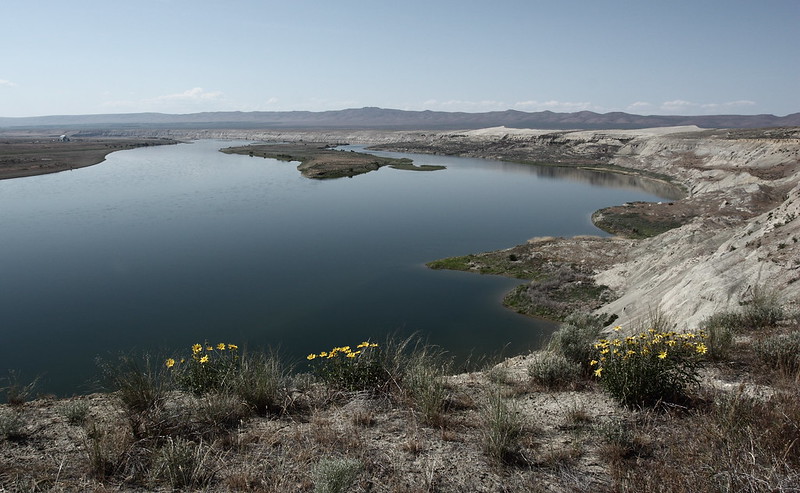
The Department of Energy (DOE) entered into negotiations with Hecate Energy, LLC for a solar project capable of delivering up to one gigawatt of clean energy within an 8,000-acre area of DOE-owned land at the Hanford nuclear site as part of the Cleanup to Clean Energy initiative.

The Hanford site is a decommissioned nuclear production complex operated by the United States government on the Columbia River in Washington. It has also been known as Site W and the Hanford Nuclear Reservation. Established in 1943 as part of the Manhattan Project, the site was home to the Hanford Engineer Works and B Reactor, the first full-scale plutonium production reactor in the world. Plutonium manufactured at the site was used in the first atomic bomb, which was tested in the Trinity nuclear test, and in the Fat Man bomb used in the bombing of Nagasaki. For more Hanford’s history, click here.

DOE says the Cleanup to Clean Energy initiative aims to repurpose parts of DOE-owned lands to support the growth of America’s clean energy economy. The latest announcement reinforces the Biden-Harris Administration’s “whole-of-government approach to leveraging federal properties to increase the deployment of clean power through the buildout of utility-scale clean energy projects.”   

Secretary of Energy Jennifer M. Granholm said,  “Since the beginning of the Biden-Harris Administration, we’ve added nearly 90 gigawatts of solar capacity to the grid—enough to power roughly 13 million homes—and we’re building on this historic progress with another massive solar project,” She added that through this latest announcement,  DOE is transforming thousands of acres of land at the Hanford site into a thriving center of carbon-free solar power generation.”

Hecate Energy, LLC was selected to negotiate a real estate agreement for up to 8,000 acres at Hanford that DOE is making available for the development of a gigawatt-scale solar photovoltaic system with battery storage.

The selection was made through a competitive qualifications-based process for evaluating and ranking proposals. The selection comes after public comments on a request for information in August 2023, a Cleanup to Clean Energy information day at Hanford in September 2023, and a request for qualifications issued in March 2024. DOE and Hecate Energy will negotiate a realty agreement; DOE may cancel negotiations and rescind the selection for any reason during this process.

While cleanup at the huge Hanford site could take 50 years, the solar project might be up and running in five to seven years.

In addition to supporting the Administration’s clean energy goals, this project has the potential to benefit the Hanford site, Tribal Nations, and surrounding communities, while complementing local efforts to plan for the future. DOE will complete environmental review and applicable regulatory processes, and continue to communicate and partner with industry, Tribal Nations, communities, stakeholders, regulators, and others as clean energy projects are developed on DOE land. 

More information on the Cleanup to Clean Energy initiative can be found here

Seattle: The smartest U.S. city

Seattle by Edward Stojacovic via Flickr CC

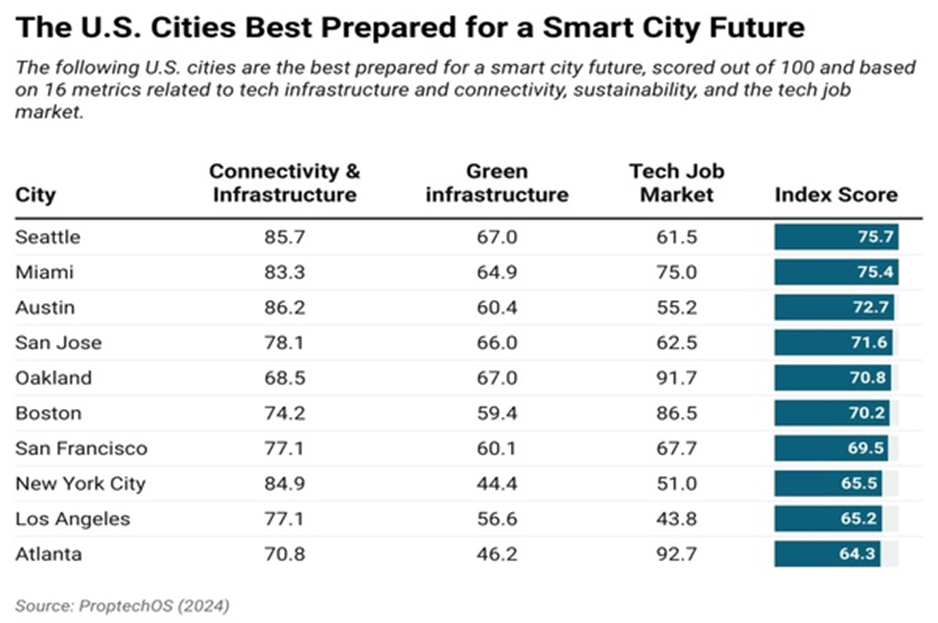
Seattle is the smartest U.S. city, an index report by ProptechOS reveals. Seattle overtook last year’s winner, Austin, Texas, to rank as the smartest city in the United States in 2024, with an overall score of 75.7 out of 100.

“Home to the likes of Amazon and Microsoft, Seattle scores highly in our research for tech infrastructure, with 34 AI companies and 13 IoT companies per 100,000 people,” the report says.

On sustainability, Seattle expanded its tree coverage by 13,700 hectares between 2010 and 2020 and built the equivalent of ten electric vehicle recharging points per 100,000 people.

To determine which cities are the smartest in 2024, ProptechOS analyzed 16 metrics related to connectivity and infrastructure, sustainability, and the tech job market. The report then ranked cities in Europe and the United States and created a weighted index.

The report analyzes three main metrics:

Tech infrastructure and connectivity, including:

  • The number of free WiFi hotspots
  • The number of AI companies
  • The number of AI companies per 100,000 people
  • The number of IoT (Internet of Things) companies 
  • The number of IoT (Internet of Things) companies per 100,000 people
  • Average broadband download speeds (Mbps)
  • Median 5G coverage of population per network provider
  • The number of airports

Green infrastructure:

  • Air quality (exposure to PM2.5)
  • 10-year tree loss (hectares)
  • 10-year tree gain (hectares)
  • The number of electric vehicle charging points
  • The number of electric vehicle charging points per 100,000 people
  • The number of LEED-certified green buildings


The tech job market:

  • The number of tech jobs advertised
  • The number of tech jobs advertised per 100,000 people

So, what is the smartest European city? Paris!

The French capital ranks the highest in Europe among cities best prepared for a smart city future, with an overall score of 76.4, overtaking last year’s winner, London.

Paris leads with several metrics, including 99.9% 5G coverage of the population by the average network provider. It has Europe’s second-highest number (532) of AI specialist companies, and the third-highest number (10,663) of free Wi-Fi hotspots, the report says.

“Paris is also known for its smart traffic management systems, which help monitor noise levels, air quality, and other environmental factors.”

The sponge knows?

               Sponge by Olly Clarke via Flickr CC

Perhaps it should be net-below-zero. 

According to a study in Nature, the planet has already passed the 1.5 °C warming threshold that climate crisis experts are saying is the goal for climate action.

At the 2015 Paris Climate Accords, nations agreed not to exceed 1.5 °C, a main guardrail of climate change. But the problem is that the planet has already passed 1.5 °C of warming, according to a new measuring technique that goes back further in time than current methods. The technique involves dating ancient sponges.

“We have an alternate record of global warming,” said coral-reef geochemist Malcolm McCulloch, at the University of West Australia Oceans Institute in Crawley, and lead author of the study. “It looks like temperatures were underestimated by about half a degree.”

However, McCulloch says that long-lived marine sponges can provide indications of temperature as far back as the eighteenth century. He and his colleagues analyzed the ratio of the elements strontium to calcium in the 300-year-old calcium carbonate skeletons of a coral-like species of sponge, Ceratoporella nicholsoni, that grows off the coasts of Puerto Rico. This ratio changes only with changes in water temperature, making it a sort of thermometer, according to the study published in Nature Climate Change.

The sponges were sampled from one particular section in the Caribbean — the only place where they are found. They were collected at a depth of 33–91 meters, in what’s called the ocean mixed layer. “Sea-surface temperature can be highly variable on top,” McCulloch was quoted as saying. “But this mixed layer represents the whole system down to a couple hundred meters, and it’s in equilibrium with the temperatures in the atmosphere.”

The sponge skeletons suggest that the planet started to warm up in the mid-1860s, during the period currently defined as the pre-industrial baseline.

“The baseline is where we measure our current temperatures from, so when we say 1.5 [degrees of warming], it’s to do with this reference point,” said McCulloch.

McCulloch and colleagues have calculated that global temperatures had in fact increased by 0.5 °C more than what was estimated by the IPCC. “That’s a huge difference relative to the total amount of warming,” says McCulloch. Furthermore, the planet exceeded 1.5 °C of warming by around 2010–2012 and is on track to surpass 2 °C in the next few years.

Climate change is all about calibration and constantly trying to catch up; our planet operates on its own time schedule, no matter how hard we try to understand.

Charge where you are….

The grants will help Washington communities build and update charging infrastructure for EVs. 

The Washington Department of Ecology is offering $3.5 million in grants over the next two years to purchase and install Level 2 charging stations and upgrade existing charging stations in public, fleet, workplace, and residential locations.

Washington businesses, Tribes, nonprofits, public entities, and multi-family residences are eligible to apply for the electric vehicle (EV) charging infrastructure grants.

The so-called “Charge Where You Are” grants are intended to attract applicants from a wide range of community groups over multiple funding rounds. The department says the first installment will distribute $1 million, with priority given to projects in rural areas, as well as neighborhoods with limited access to EV charging and communities that are disproportionately affected by air pollution. Funding for the grants comes from Washington’s Volkswagen diesel emissions settlement. Applications for the first round are open now through Nov. 16.

“Not everyone lives where they can charge an EV in their garage every night,” said Molly Spiller, manager of the Pollution Reduction Grants Section in Ecology’s Air Quality Program. “By making more charging stations available in apartments, multi-family homes, workplaces, and public locations, such as parks and libraries, we can help make EV ownership a reality for more drivers.”

With a 240-volt output, Level 2 chargers are commonly used in offices and public spaces. Although slower than the fast chargers found along highways and major road corridors, they can recharge most EVs in 4 to 10 hours.

Kathy Taylor, Air Quality Program manager, says, “We estimate the Level 2 projects we fund will help reduce greenhouse gas emissions by about 2,200 tons per year.”

Ecology anticipates opening additional grants for faster, direct current (DC) EV charging stations in 2024.

Related info:                                                    

Los Angeles, Long Beach, and Shanghai Ports Implement Outline for First trans-Pacific Green Shipping Corridor

The creation of the first green shipping corridor across the Pacific is taking shape.

Credit: U.S. Naval Institute/Shutterstock

Last week a voluntary partnership of maritime goods movement stakeholders, including the Ports of Los Angeles, Long Beach and Shanghai, some of the largest carriers in the world, and key leading cargo owners unveiled a Green Shipping Corridor Implementation Plan Outline designed to accelerate emissions reductions on one of the world’s busiest container shipping routes across the Pacific Ocean.

The plan, the first of its kind, was developed with support from C40 Cities as part of their effort to reduce carbon emissions from the largest cities in the world.

A joint press release from the stakeholders says the plan “is an important step toward decarbonizing the global supply chains that power our economies and transitioning toward zero lifecycle carbon emission ships.” In addition, it will showcase “cutting-edge goods movement technologies, decarbonization applications and best management practices to enhance efficiency, and catalyze technological, economic and policy efforts to progressively decarbonize shipping and port-related activities.” 

Carrier partners will begin deploying reduced or zero lifecycle carbon capable ships on the corridor by 2025, and work together to demonstrate by 2030 the feasibility of deploying the world’s first zero lifecycle carbon emission container ship(s).

Carrier partners include CMA CGM, COSCO Shipping Lines Co., Ltd., Maersk, and ONE. Core partners include the Shanghai International Port (Group) Co., Ltd., the China Classification Society, and the Maritime Technology Cooperation Centre of Asia.   

Partnership participants will take steps to reduce carbon emissions and harmful pollutant emissions impacting air quality, through methods such as expanding the use of shore power and supporting the development of clean marine fueling infrastructure. Cargo owner partners have set goals to contract with carriers to use zero lifecycle carbon emission shipping services, and in an effort to measure progress toward decarbonization, all partners will develop metrics to track decarbonization progress. 

Gene Seroka, Executive Director of the Port of Los Angeles, said, “This trans-Pacific green corridor will be a model for the global cooperation needed to accelerate change throughout the maritime industry. Most of the emissions associated with moving cargo by ship occur in the mid-ocean part of the journey between ports.  This corridor will help reduce mid-ocean emissions while continuing the work we have done to cut emissions within our ports.”

The initiative will drive emissions reductions across the world’s largest ocean and lead to greener practices from supply chain participants along these vital trade routes, added Mario Cordero, Chief Executive Officer of the Port of Long Beach. “The new and innovative vessel technologies, increased availability of sustainable fuels and better practices created through this green corridor will also impact society’s transition to a cleaner future far beyond the areas served by our ports.”

 C40 Cities is a network of world cities that are working to deliver the urgent action needed “to confront the climate crisis and create a future where everyone, everywhere can thrive.” Mayors of C40 cities are committed to using a science-based and people-focused approach to help the world limit global heating to 1.5°C and build healthy, equitable and resilient communities. Through a Global Green New Deal, mayors are working alongside a broad coalition of representatives from labor, business, the youth climate movement and civil society to go further and faster than ever before. 

Established in 2004, Shanghai Municipal Transportation Commission (SMTC) undertakes the management and safety supervision of the highways and urban roads, road transportation and urban traffic, ports and shipping, and other transportation industries in Shanghai. SMTC also leads the development of the Shanghai International Shipping Center. SMTC coordinates the air, rail and postal transportation management. SMTC aims to optimize the layout of the transport structure, comprehensively balance the transport capacity, and build an integrated transportation system in Shanghai.

Read the Green Shipping Corridor Implementation Plan Outline.

Watch a video about the Green Shipping Corridor.

California Grants Target Big Bucks for Net-Zero Efforts

The California State Transportation Agency (CalSTA) this month announced $1.5 billion in grants as part of efforts to build a “more efficient, sustainable and resilient supply chain.” The program includes approximately $450 million for zero-emission infrastructure, locomotives, vessels and vehicles.

Port of Long Beach CA by Ken Harrell via Flickr CC

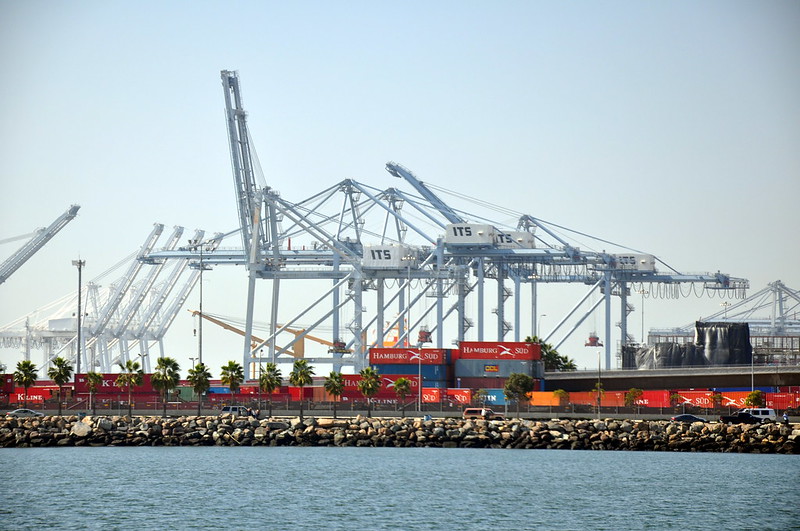
A major chunk of the funding includes a $383.35 million grant for the Port of Long Beach to complete a series of construction and clean-air technology projects to “accelerate” the transformation to zero-emissions operations and enhance the reliability and efficiency of cargo movement.

Also, as part of the state’s Port and Freight Infrastructure Program, nearly $225 million will fund a variety of zero-emissions cargo-moving equipment and support infrastructure projects across the Port of Long Beach, including “top handlers” and other manually operated cargo-handling equipment, as well as tugboats and locomotives. The sum is the single largest grant the port has received to support the zero-emissions goals of the 2017 Clean Air Action Plan Update.

The Port of Los Angeles will receive $233 million in grants from the state to complete infrastructure projects aimed at creating a more efficient and sustainable supply chain. “This nearly quarter-billion-dollar investment in critical Port of Los Angeles projects –– along with an additional $191 million in supporting regional projects –– will accelerate our efforts to boost competitiveness, create jobs and enhance decarbonization efforts,” said Port of Los Angeles Executive Director Gene Seroka. 

The Port of Oakland was awarded $119 million in grant funding from the state under the Port Freight Infrastructure Program (PFIP). The funding will support infrastructure improvements at the port’s maritime facilities and roadways, and to electrify port cargo handling equipment. 

A complete list of projects is available at the following links:

The funding – particularly the investments in zero-emission projects, which account for nearly 40 percent of the Port and Freight Infrastructure Program awards – builds on a partnership between the governments of California and Japan announced in March to collaborate on strategies to cut planet-warming pollution at seaports and establish green shipping corridors as part of the state’s broader strategy to aggressively combat and adapt to climate change.

The investments also follow the California Transportation Commission’s recent approval of $1.1 billion for infrastructure improvements on high-volume freight corridors as part of the Trade Corridor Enhancement Program (TCEP) – for a total state investment in supply chain infrastructure of more than $2.6 billion this month.