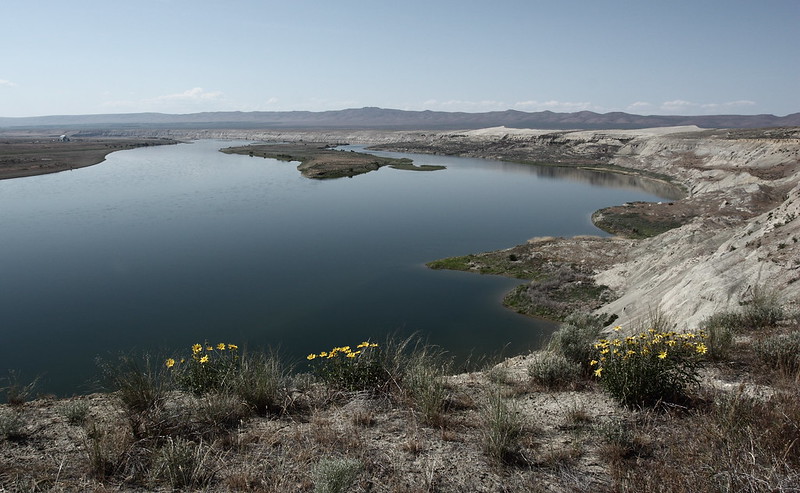
Hanford going solar

Hanford by Nicholas Blumhardt vi Flickr CC

The Department of Energy (DOE) entered into negotiations with Hecate Energy, LLC for a solar project capable of delivering up to one gigawatt of clean energy within an 8,000-acre area of DOE-owned land at the Hanford nuclear site as part of the Cleanup to Clean Energy initiative.

The Hanford site is a decommissioned nuclear production complex operated by the United States government on the Columbia River in Washington. It has also been known as Site W and the Hanford Nuclear Reservation. Established in 1943 as part of the Manhattan Project, the site was home to the Hanford Engineer Works and B Reactor, the first full-scale plutonium production reactor in the world. Plutonium manufactured at the site was used in the first atomic bomb, which was tested in the Trinity nuclear test, and in the Fat Man bomb used in the bombing of Nagasaki. For more Hanford’s history, click here.

DOE says the Cleanup to Clean Energy initiative aims to repurpose parts of DOE-owned lands to support the growth of America’s clean energy economy. The latest announcement reinforces the Biden-Harris Administration’s “whole-of-government approach to leveraging federal properties to increase the deployment of clean power through the buildout of utility-scale clean energy projects.”   

Secretary of Energy Jennifer M. Granholm said,  “Since the beginning of the Biden-Harris Administration, we’ve added nearly 90 gigawatts of solar capacity to the grid—enough to power roughly 13 million homes—and we’re building on this historic progress with another massive solar project,” She added that through this latest announcement,  DOE is transforming thousands of acres of land at the Hanford site into a thriving center of carbon-free solar power generation.”

Hecate Energy, LLC was selected to negotiate a real estate agreement for up to 8,000 acres at Hanford that DOE is making available for the development of a gigawatt-scale solar photovoltaic system with battery storage.

The selection was made through a competitive qualifications-based process for evaluating and ranking proposals. The selection comes after public comments on a request for information in August 2023, a Cleanup to Clean Energy information day at Hanford in September 2023, and a request for qualifications issued in March 2024. DOE and Hecate Energy will negotiate a realty agreement; DOE may cancel negotiations and rescind the selection for any reason during this process.

While cleanup at the huge Hanford site could take 50 years, the solar project might be up and running in five to seven years.

In addition to supporting the Administration’s clean energy goals, this project has the potential to benefit the Hanford site, Tribal Nations, and surrounding communities, while complementing local efforts to plan for the future. DOE will complete environmental review and applicable regulatory processes, and continue to communicate and partner with industry, Tribal Nations, communities, stakeholders, regulators, and others as clean energy projects are developed on DOE land. 

More information on the Cleanup to Clean Energy initiative can be found here

Beam it down! Solar farms in space!

London, United Kingdom by NASA via Flickr CC

Euronews is reporting that giant solar farms orbiting the planet may someday power Europe. The European Space Agency (ESA) unveiled a plan to harvest the sun’s energy in space and beam it back down to Earth.

It’s an idea that has been around for a while, and the subject of science fiction stories, but now it is closer to science fact. The technology is still in the preliminary testing phase, but the goal is the construction of a 2-kilometer (1.2 mile) long solar space farm, generating as much energy as a nuclear power plant, according to Hannah Brown with the European Broadcasting Union (EBU). The farm would orbit about 36,000 kilometers above the Earth.

“[Such a project] would ensure that Europe becomes a key player– and potentially leader – in the international race towards scalable clean energy solutions for mitigating climate change,” the ESA said in a statement.

Solar power is a great source of clean energy, but it’s held back by some limitations. For example, solar panels can only harness power in the daytime, and even then, much of the sunlight is absorbed by the atmosphere on its journey to the ground. But in space, the sun’s beams are around ten times as intense as they are on Earth.

The ESA has partnered with Airbus to develop ‘wireless power transmission’ to capture this 24-hour source of electricity and beam it down to us. The technology is based on the transmission used by TV and communication satellites every day, Airbus engineer Nicolas Schneider explained: “We are not very far from a 4G antenna, except that what we want is not to radiate in all directions, we want to be very precise like a laser, in fact. It’s a wave that can be directed to this receiving antenna which will then transform this wave into electricity.”

The problem is one of scale. The satellite would be massive, and so difficult to launch and build. But doable.

With mega-billionaires so interested in playing around in space, maybe they should spend a few billion for this and become energy czars.

Let’s do this!

Port Offers Solar Power Project Funding

RMS Queen Mary/Long Beach, CA by Jason Mrchina via Flikr CC

The Port of Long Beach is accepting “concept paper” proposals for solar power generation projects that qualify for funding under the port’s Community Grants Program.

The Community Grants Program encompasses more than $46 million to fund projects that help those in the community who are most vulnerable to port-related impacts and to reduce greenhouse gases. These projects include expanding asthma services, controlling stormwater runoff through the building of permeable parking lots, and creating open space buffers between port operations and communities, to name a few. Combined with a previous program started in 2009, the Port of Long Beach has set aside more than $65 million, making it the largest voluntary port mitigation initiative in the country. To date, $36.5 million has been committed.

Projects that receive grants will serve people most sensitive to port impacts, including seniors, pregnant women, children, and those with asthma or chronic illnesses. Public and private agencies are eligible to apply, however, home improvements are not eligible. To view the program’s relevant Facilities Improvements guidelines and the pre-solicitation workshop, go to www.polb.com/grantopportunities.

Applicants are required to describe proposed projects at a high leve, the port says,l and program staff will determine project and applicant eligibility. Concept papers must be submitted online and are due by 4 p.m. Wednesday, Nov. 23.

The Port of Long Beach is a gateway for the trans-Pacific trade. With 175 shipping lines connecting Long Beach to 217 seaports, the Long Beach handles $200 billion in trade annually, supporting more than 575,000 Southern California jobs.

The grant program contact is Jennifer Williams, Environmental Specialist Associate, at (562) 283-7133, grants@polb.com