Impact of Trump’s NCA Dismissals: A Scientific Response

Road to Nowhere by Renate via Flickr CC

US science organizations to pick up on Trump’s abandonment of NCA

Two major US scientific organizations, American Meteorological Society and American Geophysical Union, will work together to produce more than 29 peer-reviewed journals covering all aspects of climate change, including observations, projections, impacts, risks and solutions.

The AP and the Guardian reported on the development late last week after the Trump administration dismissed all contributors to the sixth National Climate Assessment (NCA), the US government’s major study on climate change. The dismissal of nearly 400 contributors left the future of the study in doubt; it had been scheduled for publication in 2028.

The NCA has been overseen by the NASA-supported Global Change Research Program, a US climate body that the Trump administration also dismissed last month. The reports, published since 2000, coordinated input from 14 federal agencies and hundreds of scientists.

Speaking to the Associated Press, Katharine Hayhoe, a Texas Tech University climate professor and chief scientist at The Nature Conservancy, said the collaboration between AMS and AGU “is a testament to how important it is that the latest science be summarized and available.”

Hayhoe, who was a lead author of reports in 2009, 2018 and an author of the one in 2023, added: “People are not aware of how climate change is impacting the decisions that they are making today, whether it’s the size of the storm sewer pipes they’re installing, whether it is the expansion of the flood zone where people are building, whether it is the increases in extreme heat.”

In addition to widespread dismissals across federal agencies, federal websites have been purged of information pertaining to climate change and extreme weather events since Trump took office in January.

The NCA report is required by a 1990 federal law and was due out around 2027. Preliminary budget documents show slashed funding or elimination of offices involved in coordinating thereport, scientists and activists said in an AP report.

“We are filling in a gap in the scientific process,” AGU President Brandon Jones said. “It’s more about ensuring that science continues.”

Meteorological society past president Anjuli Bamzi, a retired federal atmospheric scientist who has worked on previous National Climate Assessments, said one of the most important parts of the federal report is that it projects 25 and 100 years into the future.

With the assessment, “We’re better equipped to deal with the future,” Bamzi said. “We can’t be an ostrich and put our head in the sand and let it go.”

In the announcement on Friday, the two societies said: “This effort aims to sustain the momentum of the sixth National Climate Assessment (NCA), the authors and staff of which were dismissed earlier this week by the Trump administration, almost a year into the process.”

According to the AMS and AGU, the collection will not replace the NCA but instead create a mechanism for important work on climate change’s impact to continue.

“It’s incumbent on us to ensure our communities, our neighbors, our children are all protected and prepared for the mounting risks of climate change,” AGU’s president, Brandon Jones, said.

“This collaboration provides a critical pathway for a wide range of researchers to come together and provide the science needed to support the global enterprise pursuing solutions to climate change,” he added.

Similarly, the AMS president, David Stensrud, said: “Our economy, our health, our society are all climate-dependent. While we cannot replace the NCA, we at AMS see it as vital to support and help expand this collaborative scientific effort for the benefit of the US public and the world at large.”

The last climate assessment report, released in 2023, said that climate change is “harming physical, mental, spiritual, and community health and well-being through the increasing frequency and intensity of extreme events, increasing cases of infectious and vector-borne diseases, and declines in food and water quality and security.”

In 2018, during Trump’s first term, the assessment was just as blunt, saying: “Climate change creates new risks and exacerbates existing vulnerabilities in communities across the United States, presenting growing challenges to human health and safety, quality of life, and the rate of economic growth.”

Is this the start of push-back on Trump? If so, Yes!

Related reading (from AP):

The world’s biggest companies have caused $28 trillion in climate damage, a new study stimates.

Trump’s push to save fading coal industry gets warm West Virginia embraceEPA announces broad reorganization that includes shuffle of scientific research
Hanford going solar

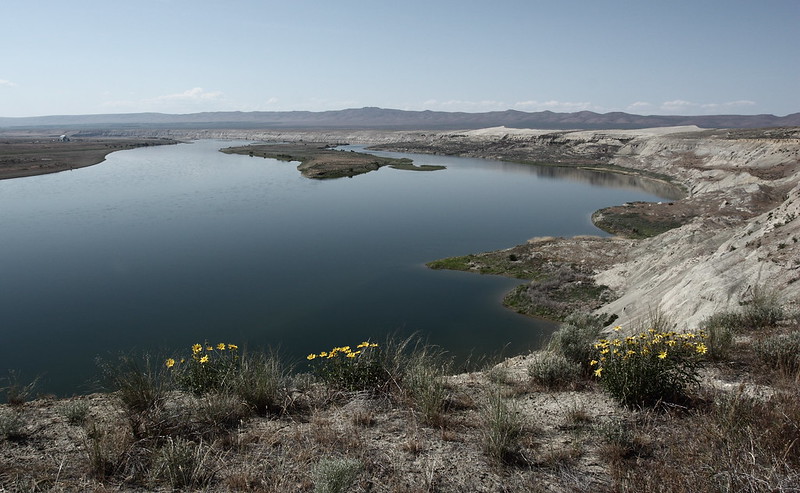
Hanford by Nicholas Blumhardt vi Flickr CC

The Department of Energy (DOE) entered into negotiations with Hecate Energy, LLC for a solar project capable of delivering up to one gigawatt of clean energy within an 8,000-acre area of DOE-owned land at the Hanford nuclear site as part of the Cleanup to Clean Energy initiative.

The Hanford site is a decommissioned nuclear production complex operated by the United States government on the Columbia River in Washington. It has also been known as Site W and the Hanford Nuclear Reservation. Established in 1943 as part of the Manhattan Project, the site was home to the Hanford Engineer Works and B Reactor, the first full-scale plutonium production reactor in the world. Plutonium manufactured at the site was used in the first atomic bomb, which was tested in the Trinity nuclear test, and in the Fat Man bomb used in the bombing of Nagasaki. For more Hanford’s history, click here.

DOE says the Cleanup to Clean Energy initiative aims to repurpose parts of DOE-owned lands to support the growth of America’s clean energy economy. The latest announcement reinforces the Biden-Harris Administration’s “whole-of-government approach to leveraging federal properties to increase the deployment of clean power through the buildout of utility-scale clean energy projects.”   

Secretary of Energy Jennifer M. Granholm said,  “Since the beginning of the Biden-Harris Administration, we’ve added nearly 90 gigawatts of solar capacity to the grid—enough to power roughly 13 million homes—and we’re building on this historic progress with another massive solar project,” She added that through this latest announcement,  DOE is transforming thousands of acres of land at the Hanford site into a thriving center of carbon-free solar power generation.”

Hecate Energy, LLC was selected to negotiate a real estate agreement for up to 8,000 acres at Hanford that DOE is making available for the development of a gigawatt-scale solar photovoltaic system with battery storage.

The selection was made through a competitive qualifications-based process for evaluating and ranking proposals. The selection comes after public comments on a request for information in August 2023, a Cleanup to Clean Energy information day at Hanford in September 2023, and a request for qualifications issued in March 2024. DOE and Hecate Energy will negotiate a realty agreement; DOE may cancel negotiations and rescind the selection for any reason during this process.

While cleanup at the huge Hanford site could take 50 years, the solar project might be up and running in five to seven years.

In addition to supporting the Administration’s clean energy goals, this project has the potential to benefit the Hanford site, Tribal Nations, and surrounding communities, while complementing local efforts to plan for the future. DOE will complete environmental review and applicable regulatory processes, and continue to communicate and partner with industry, Tribal Nations, communities, stakeholders, regulators, and others as clean energy projects are developed on DOE land. 

More information on the Cleanup to Clean Energy initiative can be found here

Seattle: The smartest U.S. city

Seattle by Edward Stojacovic via Flickr CC

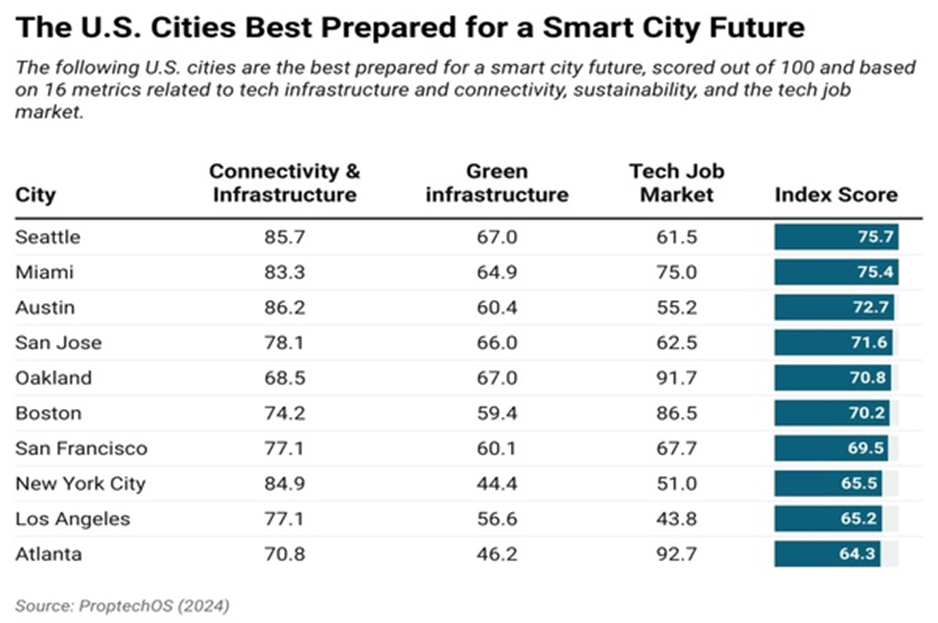
Seattle is the smartest U.S. city, an index report by ProptechOS reveals. Seattle overtook last year’s winner, Austin, Texas, to rank as the smartest city in the United States in 2024, with an overall score of 75.7 out of 100.

“Home to the likes of Amazon and Microsoft, Seattle scores highly in our research for tech infrastructure, with 34 AI companies and 13 IoT companies per 100,000 people,” the report says.

On sustainability, Seattle expanded its tree coverage by 13,700 hectares between 2010 and 2020 and built the equivalent of ten electric vehicle recharging points per 100,000 people.

To determine which cities are the smartest in 2024, ProptechOS analyzed 16 metrics related to connectivity and infrastructure, sustainability, and the tech job market. The report then ranked cities in Europe and the United States and created a weighted index.

The report analyzes three main metrics:

Tech infrastructure and connectivity, including:

  • The number of free WiFi hotspots
  • The number of AI companies
  • The number of AI companies per 100,000 people
  • The number of IoT (Internet of Things) companies 
  • The number of IoT (Internet of Things) companies per 100,000 people
  • Average broadband download speeds (Mbps)
  • Median 5G coverage of population per network provider
  • The number of airports

Green infrastructure:

  • Air quality (exposure to PM2.5)
  • 10-year tree loss (hectares)
  • 10-year tree gain (hectares)
  • The number of electric vehicle charging points
  • The number of electric vehicle charging points per 100,000 people
  • The number of LEED-certified green buildings


The tech job market:

  • The number of tech jobs advertised
  • The number of tech jobs advertised per 100,000 people

So, what is the smartest European city? Paris!

The French capital ranks the highest in Europe among cities best prepared for a smart city future, with an overall score of 76.4, overtaking last year’s winner, London.

Paris leads with several metrics, including 99.9% 5G coverage of the population by the average network provider. It has Europe’s second-highest number (532) of AI specialist companies, and the third-highest number (10,663) of free Wi-Fi hotspots, the report says.

“Paris is also known for its smart traffic management systems, which help monitor noise levels, air quality, and other environmental factors.”

Study Boosts Development of LA/LB to Singapore Green Shipping Corridor

Singapore by Sarah Lou via Flickr CC

A study conducted by the maritime classification society American Bureau of Shipping this month says a green and digital shipping corridor (GDSC) between Singapore, Los Angeles and Long Beach might create more than 700 jobs in zero- and near-zero emission fuel production by 2030.

The study, commissioned by Singapore’s Maritime & Port Authority (MPA) and the ports of Los Angeles and Long Beach, also found that the corridor could also lead to health improvements for local communities, as well as economic benefits for participating countries.

The Port of Singapore’s strategic location makes it “one of the busiest and leading container trans-shipment hubs, connecting Asian markets to more than 600 ports in over 120 countries around the world,” the study says. Meanwhile, the ports of Los Angeles and Long Beach are the leading U.S. gateways for trans-Pacific trade. “The trans-Pacific trade route between Singapore and Los Angeles/ Long Beach is a “critical enabler” of the strong economic relationship between Singapore and California.

According to APEC (Asia Pacific Economic Corporation), bilateral trade reached $10.344 billion in 2022, establishing Singapore as California’s 12th-largest trading partner. Additionally, California ranks as Singapore’s second-largest trading partner among all U.S. states, representing 13.3% of the national trade in Singapore.

According to the study, the ports of Singapore, Los Angeles and Long Beach already play a “significant role in maritime decarbonization.”

MPA wants to reduce emissions from port terminals by at least 60% from 2005 levels by 2030, and to achieve net zero by 2050. “MPA also aims to reduce absolute emissions from domestic harbor craft fleet by 15% from 2021 levels by 2030, and half the emissions from 2030-level by 2050.”

Singapore is developing various net-zero fuel pathways, including focusing on electrification and biofuels for domestic harbor crafts and building up the value chain for ammonia and methanol for international shipping.

The ports of LA and LB have signed green shipping corridor agreements with ports in Asia to deploy ships with full life cycle low or even zero carbon emission capabilities in this corridor. Since the announcement of the ZEERO (Zero Emissions, Energy Resilient Operation) commitment, Long Beach has invested $300 million in establishing a green fuel hub to cut carbon emissions by 91% since 2005. In 2023, The MPA, the ports of Los Angeles and  Long Beach, with the support of C40 Cities, established the Green and Digital Shipping Corridor (GDSC) to accelerate decarbonization of the maritime industry and the development and deployment of digital technology solutions and enablers

The study provides a baseline of activities and energy demand requirements for vessels operating on the corridor through 2050. The study estimates the quantity of near-zero and zero-emission fuels required for this traffic by modeling the adoption of zero and near-zero carbon alternative fuels by vessels operating on the corridor through 2050, considering various parameters such as fuel production costs and fuel availability, and in view of the targets in the 2023 International Maritime Organization’s Strategy on Reduction of Greenhouse Gas Emissions from Ships. (The study can be found at c40.me/3xF60Yw.)

“The Port of Long Beach and its partners have been very successful in reducing emissions from cargo-handling equipment, trucks and other mobile sources moving cargo in our harbor,” said Port of Long Beach CEO Mario Cordero. “One of the most important parts of this partnership is it allows us to better understand and target a source of emissions that is hard for us to control as a local seaport authority – shipborne emissions. This work, vital to our net zero-emission quest, will result in economic and health benefits all along the trans-Pacific trade corridor.”

“This study provides a sense of scale and scope to inform our implementation of the Green and Digital Shipping Corridor,” said Port of Los Angeles Executive Director Gene Seroka. “Achieving the reductions of greenhouse gas emissions required will take coordination and commitment from public and private stakeholders across the maritime and goods movement industries. We’re proud to be collaborating with industry partners to make this corridor a reality.”

A U.S. State Department fact sheet on the green corridor framework notes that green shipping corridors can “spur early and rapid adoption of fuels and technologies that, on a lifecycle basis, deliver low- and zero-emissions across the maritime sector, placing the sector on a pathway to full decarbonization.  

“The United States envisions green shipping corridors as maritime routes that showcase low- and zero-emission lifecycle fuels and technologies with the ambition to achieve zero greenhouse gas emissions across all aspects of the corridor in support of sector-wide decarbonization no later than 2050.” 

In a related green corridor development, X-Press Feeders, a large independent common carrier, has signed of a memorandum of understanding with six European ports: Port of Antwerp Bruges (Belgium), Port of Tallinn (Estonia), Port of Helsinki (Finland), Port of HaminaKotka (Finland), Freeport of Riga (Latvia) and Klaipeda Port (Lithuania). 

Through the MOU, X-Press Feeders and the participating ports will pool resources and expertise to develop and implement sustainable practices for maritime operations. 

The collaboration between the parties will begin with the establishment of these two shipping routes: 

Green Baltic X-PRESS (GBX): Rotterdam – Antwerp Bruges – Klaipeda – Riga – Rotterdam 

Green Finland X-PRESS (GFX): Rotterdam – Antwerp Bruges – Helsinki – Tallinn – HaminaKotka – Rotterdam 

These services are scheduled to begin in the third quarter of this year. This development is significant as these will be the very first scheduled feeder routes in Europe powered by green methanol, an alternative fuel that produces at least 60% less greenhouse gas emissions than conventional marine fuel. 

X-Press Feeders operates a fleet of more than 100 vessels, calling at more than 180 ports worldwide. X-Press Feeders aims to achieve net-zero emissions by 2050.

The sponge knows?

               Sponge by Olly Clarke via Flickr CC

Perhaps it should be net-below-zero. 

According to a study in Nature, the planet has already passed the 1.5 °C warming threshold that climate crisis experts are saying is the goal for climate action.

At the 2015 Paris Climate Accords, nations agreed not to exceed 1.5 °C, a main guardrail of climate change. But the problem is that the planet has already passed 1.5 °C of warming, according to a new measuring technique that goes back further in time than current methods. The technique involves dating ancient sponges.

“We have an alternate record of global warming,” said coral-reef geochemist Malcolm McCulloch, at the University of West Australia Oceans Institute in Crawley, and lead author of the study. “It looks like temperatures were underestimated by about half a degree.”

However, McCulloch says that long-lived marine sponges can provide indications of temperature as far back as the eighteenth century. He and his colleagues analyzed the ratio of the elements strontium to calcium in the 300-year-old calcium carbonate skeletons of a coral-like species of sponge, Ceratoporella nicholsoni, that grows off the coasts of Puerto Rico. This ratio changes only with changes in water temperature, making it a sort of thermometer, according to the study published in Nature Climate Change.

The sponges were sampled from one particular section in the Caribbean — the only place where they are found. They were collected at a depth of 33–91 meters, in what’s called the ocean mixed layer. “Sea-surface temperature can be highly variable on top,” McCulloch was quoted as saying. “But this mixed layer represents the whole system down to a couple hundred meters, and it’s in equilibrium with the temperatures in the atmosphere.”

The sponge skeletons suggest that the planet started to warm up in the mid-1860s, during the period currently defined as the pre-industrial baseline.

“The baseline is where we measure our current temperatures from, so when we say 1.5 [degrees of warming], it’s to do with this reference point,” said McCulloch.

McCulloch and colleagues have calculated that global temperatures had in fact increased by 0.5 °C more than what was estimated by the IPCC. “That’s a huge difference relative to the total amount of warming,” says McCulloch. Furthermore, the planet exceeded 1.5 °C of warming by around 2010–2012 and is on track to surpass 2 °C in the next few years.

Climate change is all about calibration and constantly trying to catch up; our planet operates on its own time schedule, no matter how hard we try to understand.

You can afford it!

Confusion and lack of clarity abounds when it comes to implementing a carbon tax and various decarbonization proposals and goals. It’s all a game: trying to avoid costs and even making money (at least breaking even) from emission trading systems.

Decarbonization by IRENA via Flickr CC

As one knowledgeable observer noted recently, “There is little to no appetite currently among beneficial cargo owners (BCOs) to pay up for decarbonized ocean container transport. There remains a wide variance in the emission trading system (ETS) surcharge estimates by carriers that illustrates the uncertainty over just how much the carbon tax will cost the industry.”

As Greg Knowler, Europe Editor at IHS Markit Maritime & Trade, relates in a LinkedIn post, Ocean carriers will need to comply with the European Union emissions trading system (ETS) from Jan. 1, 2024, a cap-and-trade principle that has been applied to industries in Europe since 2005 and was recently extended to cover shipping. His article continues:

“A cap is placed on the amount of CO2 that can be emitted by those within the system and companies must buy carbon allowances that cover their annual emissions. These allowances can be bought on the open carbon market or traded among companies.

“From Jan. 1, for every ton of CO2 emitted by a ship, the carrier will need to buy 1 emission allowance, called an EUA, from the carbon market. The regulation will be phased in according to a progressive schedule over the next two years. In 2024, carriers will be charged for 40% of all emissions, 70% in 2025 and 100% of emissions after 2026.

“Half of journeys that begin or end outside the EU will be covered by the ETS, and all the emissions from voyages between ports in the EU and while alongside will be covered.

“There are significant costs involved for carriers. According to emissions monitoring platform OceanScore, the maritime industry in 2022 generated CO2 emissions of 126 million tonnes from voyages to, from, between and within European ports. That would have resulted in the need to surrender 82.7 million EU Allowances (EUAs), or carbon credits, under the ETS, equating to a total cost of €6.5 billion based on the current price of €78 per EUA.  

“Hapag-Lloyd CEO Rolf Habben Jansen has estimated the ETS will cost Hapag-Lloyd $100 million in 2024, with that amount tripling in the next couple of years, and he has vowed to recover those costs from customers.”

Knowler quotes Jansen: “The initial cost is there, and we will not absorb the cost, It is real and is a fully out-of-pocket cost and people must accept it. We talk about $100 extra per container, and if you look at the value of the goods that are inside, people should be able to accept that.”

Knowler writes, “It will become harder and harder for the carriers to absorb the ETS costs as they get phased in, and as the free emission allowances across all industries gets phased out and compliance gets progressively more expensive…this is the way the system has been designed. The ETS is supposed to make it more expensive so those in the shipping industry are forced to use greener fuels and services to enable the European Union to be climate neutral by 2050.”

That last concluding bit is the point of this complicated and ultimately frustrating exercise. The bottom line is that no one wants to pay for the cost of climate change except those that can’t afford it. Climate change will exact its own high costs for everyone on this planet sooner or later.

The thing about net zero emissions and decarbonization is that while intentions are well meaning (or not) companies, especially those that use fossil fuels, don’t want to pay. God forbid that their margins and profits might decrease if they implement net zero net zero actions. Better to protect shareholders than the climate. It’s disgusting, shortsighted, and deadly,

This is the real bottom line: Do the right thing. Take the financial hit for the good of the planet! You can afford it!

Los Angeles, Long Beach, and Shanghai Ports Implement Outline for First trans-Pacific Green Shipping Corridor

The creation of the first green shipping corridor across the Pacific is taking shape.

Credit: U.S. Naval Institute/Shutterstock

Last week a voluntary partnership of maritime goods movement stakeholders, including the Ports of Los Angeles, Long Beach and Shanghai, some of the largest carriers in the world, and key leading cargo owners unveiled a Green Shipping Corridor Implementation Plan Outline designed to accelerate emissions reductions on one of the world’s busiest container shipping routes across the Pacific Ocean.

The plan, the first of its kind, was developed with support from C40 Cities as part of their effort to reduce carbon emissions from the largest cities in the world.

A joint press release from the stakeholders says the plan “is an important step toward decarbonizing the global supply chains that power our economies and transitioning toward zero lifecycle carbon emission ships.” In addition, it will showcase “cutting-edge goods movement technologies, decarbonization applications and best management practices to enhance efficiency, and catalyze technological, economic and policy efforts to progressively decarbonize shipping and port-related activities.” 

Carrier partners will begin deploying reduced or zero lifecycle carbon capable ships on the corridor by 2025, and work together to demonstrate by 2030 the feasibility of deploying the world’s first zero lifecycle carbon emission container ship(s).

Carrier partners include CMA CGM, COSCO Shipping Lines Co., Ltd., Maersk, and ONE. Core partners include the Shanghai International Port (Group) Co., Ltd., the China Classification Society, and the Maritime Technology Cooperation Centre of Asia.   

Partnership participants will take steps to reduce carbon emissions and harmful pollutant emissions impacting air quality, through methods such as expanding the use of shore power and supporting the development of clean marine fueling infrastructure. Cargo owner partners have set goals to contract with carriers to use zero lifecycle carbon emission shipping services, and in an effort to measure progress toward decarbonization, all partners will develop metrics to track decarbonization progress. 

Gene Seroka, Executive Director of the Port of Los Angeles, said, “This trans-Pacific green corridor will be a model for the global cooperation needed to accelerate change throughout the maritime industry. Most of the emissions associated with moving cargo by ship occur in the mid-ocean part of the journey between ports.  This corridor will help reduce mid-ocean emissions while continuing the work we have done to cut emissions within our ports.”

The initiative will drive emissions reductions across the world’s largest ocean and lead to greener practices from supply chain participants along these vital trade routes, added Mario Cordero, Chief Executive Officer of the Port of Long Beach. “The new and innovative vessel technologies, increased availability of sustainable fuels and better practices created through this green corridor will also impact society’s transition to a cleaner future far beyond the areas served by our ports.”

 C40 Cities is a network of world cities that are working to deliver the urgent action needed “to confront the climate crisis and create a future where everyone, everywhere can thrive.” Mayors of C40 cities are committed to using a science-based and people-focused approach to help the world limit global heating to 1.5°C and build healthy, equitable and resilient communities. Through a Global Green New Deal, mayors are working alongside a broad coalition of representatives from labor, business, the youth climate movement and civil society to go further and faster than ever before. 

Established in 2004, Shanghai Municipal Transportation Commission (SMTC) undertakes the management and safety supervision of the highways and urban roads, road transportation and urban traffic, ports and shipping, and other transportation industries in Shanghai. SMTC also leads the development of the Shanghai International Shipping Center. SMTC coordinates the air, rail and postal transportation management. SMTC aims to optimize the layout of the transport structure, comprehensively balance the transport capacity, and build an integrated transportation system in Shanghai.

Read the Green Shipping Corridor Implementation Plan Outline.

Watch a video about the Green Shipping Corridor.

California Grants Target Big Bucks for Net-Zero Efforts

The California State Transportation Agency (CalSTA) this month announced $1.5 billion in grants as part of efforts to build a “more efficient, sustainable and resilient supply chain.” The program includes approximately $450 million for zero-emission infrastructure, locomotives, vessels and vehicles.

Port of Long Beach CA by Ken Harrell via Flickr CC

A major chunk of the funding includes a $383.35 million grant for the Port of Long Beach to complete a series of construction and clean-air technology projects to “accelerate” the transformation to zero-emissions operations and enhance the reliability and efficiency of cargo movement.

Also, as part of the state’s Port and Freight Infrastructure Program, nearly $225 million will fund a variety of zero-emissions cargo-moving equipment and support infrastructure projects across the Port of Long Beach, including “top handlers” and other manually operated cargo-handling equipment, as well as tugboats and locomotives. The sum is the single largest grant the port has received to support the zero-emissions goals of the 2017 Clean Air Action Plan Update.

The Port of Los Angeles will receive $233 million in grants from the state to complete infrastructure projects aimed at creating a more efficient and sustainable supply chain. “This nearly quarter-billion-dollar investment in critical Port of Los Angeles projects –– along with an additional $191 million in supporting regional projects –– will accelerate our efforts to boost competitiveness, create jobs and enhance decarbonization efforts,” said Port of Los Angeles Executive Director Gene Seroka. 

The Port of Oakland was awarded $119 million in grant funding from the state under the Port Freight Infrastructure Program (PFIP). The funding will support infrastructure improvements at the port’s maritime facilities and roadways, and to electrify port cargo handling equipment. 

A complete list of projects is available at the following links:

The funding – particularly the investments in zero-emission projects, which account for nearly 40 percent of the Port and Freight Infrastructure Program awards – builds on a partnership between the governments of California and Japan announced in March to collaborate on strategies to cut planet-warming pollution at seaports and establish green shipping corridors as part of the state’s broader strategy to aggressively combat and adapt to climate change.

The investments also follow the California Transportation Commission’s recent approval of $1.1 billion for infrastructure improvements on high-volume freight corridors as part of the Trade Corridor Enhancement Program (TCEP) – for a total state investment in supply chain infrastructure of more than $2.6 billion this month.

Featured

FAO: Transform agrifood systems to adapt and mitigate climate change

Agriculture by StateofIsrael via Flickr CC

The UN Food and Agriculture Organization asserts that transforming agrifood systems is essential to adapt to human-caused climate change and reduce greenhouse gas emissions. FAO underscored this in response to the March report published by the Intergovernmental Panel on Climate Change (IPCC).

The Synthesis Report, the last of the Sixth Assessment report cycle, confirms that human activities, mainly through emissions of greenhouse gases, have unequivocally caused global warming. These include unsustainable energy use, land use, and land-use change, as well as consumption and production patterns.

FAO says the report “underlines that 22% of global greenhouse gas emissions right now come from agriculture, forestry, and land use.” The synthesis report also paints a clear way ahead, noting that the solution lies in climate-resilient development and holistic measures to adapt to climate change that also reduce or avoid greenhouse emissions.

“Agriculture and food security are already threatened by climate change, in particular in Small Island Developing States, Least Developed Countries and Land-Locked Countries, affecting the livelihoods of smallholder farmers, pastoralists, forest-dependent people, fishers, Indigenous Peoples and women”, said FAO Deputy Director-General Maria Helena Semedo.

“We need to act now at scale. Building sustainable and resilient agrifood systems is fundamental to tackling the climate crisis, food insecurity and biodiversity loss,” she said.

Climate action through food and agriculture

IPCC scientists highlight with high confidence that many agriculture, forestry and land use options provide adaptation and mitigation benefits that could be upscaled in the near term across most regions.

For example, conservation, improved management, and restoration of forests and other ecosystems offer the largest opportunity to counteract the economic damages caused by climate-related disasters.

 Examples of effective adaptation options include cultivar improvements, on-farm, water management and storage, soil moisture conservation, irrigation, agroforestry, community-based adaptation, farm and landscape level diversification in agriculture and sustainable land management.

The IPCC also notes the importance of integrated approaches to meet multiple objectives, including food security, and underscores that shifting to healthy diets and reducing food waste, along with sustainable agriculture, can reduce impacts on ecosystems and free up land for reforestation and biodiversity restoration.

“The report shows how agriculture can be central to climate action. It highlights that Agriculture is already impacted by climate change, showing that its adaptation is urgent to ensure food security and nutrition leaving no one behind”, FAO Deputy Director-General Semedo highlighted.

“Agriculture including crop and livestock production, forestry, fisheries and aquaculture, offers solutions that contribute to both adaptation and mitigation,” she added.

The synthesis further highlights how central water is to all sectors for their adaptation. In this context, FAO supports integrated water resources management to face water-related challenges in the context of climate change. Looking ahead, the UN 2023 Water Conference is of particular importance for Agriculture.

The FAO Strategy on Climate Change looks beyond food production by considering crops and livestock, forests, fisheries and aquaculture and related value chains, livelihoods, biodiversity and ecosystems in a holistic manner, as well as embracing the indispensable role of women, youth and Indigenous Peoples, as essential agents of change.

It considers different contexts and realities, including rural, peri-urban and urban areas, and supporting countries, as appropriate, in designing, revising and implementing agrifood systems related parts of their country-driven commitments and plans, including nationally determined contributions (NDCs), national adaptation plans (NAPs), nationally appropriate mitigation actions, long-term low greenhouse gas emission development strategies, disaster risk reduction plans and other related targets and commitments.

It’s time to implement the strategy and make the Green Climate Fund (GFC), the world’s largest climate fund mandated to support developing countries to raise and achieve the ambition of their national climate plans, an effective reality.

Since becoming partners in 2016, FAO and the GCF have been scaling up climate investments in high-impact projects that make the agriculture, forestry and fisheries sectors more efficient, inclusive, sustainable and resilient to climate change. The portfolio now exceeds over 1 billion.

State of Green Business: The Sustainability Cha-Cha

Following is an excerpt from GreenBiz Group’s 16th annual State of Green Business, which explores sustainable business trends to watch in 2023. Download the report here.

“Stay the course” is a brief summation from Joel Makower, chairman and co-founder of GreenBiz Group.

He writes: “That may be the key message coming out of the convulsing, confounding year that was 2022. For all that those 12 months threw at us — a still-raging pandemic, a global economic downturn, major supply-chain chokepoints, political upheavals, climate-exacerbated natural disasters, and a global energy crisis spurred by Russia’s unprovoked invasion of Ukraine — there’s no turning back for sustainability professionals.

“Of course, inflation and low economic growth led some companies to tap the brakes, slowing some initiatives, including the increased headcount that goes with companies’ growing sustainability ambitions. But not for long. There’s a general sense that the critical nature of social and environmental challenges, and the risks they pose to companies and society, will keep sustainability a hot-button business issue for the foreseeable future.

“It’s another round of the sustainability cha-cha: two steps forward, one step back.”

The risks are growing, he says, “but so are the rewards — to professionals, their organizations and, ultimately, to the planet and all who live here.” Since 2008, the GreenBiz editors and analysts have focused on 10 key trends worth watching, reflecting a broad spectrum of environmental and sustainability topics: transportation, carbon removal, the circular economy, climate tech, sustainable food systems, renewable energy and more.

Much of the sustainability wish list is coming to fruition, according to the report. “At last, biodiversity and natural capital are being recognized as critical inputs to business and industry; healthy ocean ecosystems are linked to climate mitigation and resilience; the financial sector, from insurance to banking to venture capital, is awakening to a post-oil future; and forthcoming transparency and disclosure frameworks promise to help separate leaders from laggards.”

Stakeholder capitalism “is alive and well, as companies and mainstream investors increasingly view environmental and social issues not as some social engineering conspiracy but as activities critical to business and macroeconomic success.”

For the 16th consecutive year, we’ve tapped the GreenBiz analyst and editorial teams to identify 10 key trends and developments GreenBiz will watch over the next 12 months. To learn more, download the free report here.