Green Corridors: Enhancing Cross-Border Freight Efficiency

Green Corridors’ GC-IFTS (Green Corridors Intelligent Freight Transportation System) “offers a solution at Port Laredo that will benefit future generations by reducing congestion, bypassing gridlocked areas, and increasing border security.” (Photo credit: Green Corridors.)

Last time, I talked about a Port of Seattle green corridor for cruises to Alaska, along with other port corridors, In this space I will look at the aptly named Green Corridors, a land-based infrastructure freight corridor using elevated tracks.

Green Corridors is an ambitious undertaking that uses technology to bypass traffic congestion by implementing “state-of-the-art, low-emission shuttles traveling on elevated guideways.”  The thinking is to remove traffic congestion by moving freight off the road and onto elevated guideways, “resulting in increased efficiency, sustainability, security and road safety.”

Green Corridors, based in Austin, Texas, offers the logistics industry innovative freight transportation services by moving semi-truck trailers and sea containers across international borders, between a seaport and an inland terminal or through key trade corridors. Designed for transportation providers, port authority and terminal operators, logistics companies will book freight directly on Green Corridors’ system.

Green Corridors’ technology includes automated inland terminals, autonomous freight shuttles, and elevated guideway infrastructure. Inland terminals will serve as hubs for commerce and logistics services.  The cost of such a project is unclear. The company says it is on a mission to improve the $300 billion international trade corridor between Laredo, Texas to Monterrey, N.L., Mexico.

According to a Mexico Business News article, published last year, the Government of Nuevo Leon and Green Corridors signed a Memorandum of Understanding (MoU) to revamp commercial corridors by integrating sustainable technologies that aim to enhance efficiency in cross-border transportation management.

During his visit to Austin, Texas, Governor of Nuevo Leon Samuel García was introduced to the project by executives from Green Corridors.

The MoU, signed by García and Mitch Carlson, CEO, Green Corridors, established a collaborative link to build a Comprehensive Intelligent Freight Transportation System (IFTS) from the Colombia-Laredo area to the Monterrey Metropolitan Zone. This system will facilitate point-to-point cargo transportation within the region, “ultimately reducing traffic congestion and boosting operational efficiency in goods movement.”

Both Green Corridors and the Government of Nuevo Leon want to develop and implement new technologies and operational methods to enhance the efficiency of cross-border and domestic freight transportation.

“The Green Corridors solution encompasses two initial projects applicable to various Ports of Entry (POEs): Seaport to Inland Terminal, and Land Border Crossing. These projects aim to mitigate congestion and security concerns at border crossings and waterfront sites by relocating freight to strategically located areas,” the article said.

One such project involves the Port of Houston, which anticipates a 75% increase in cargo volumes by 2035. This growth is also expected to exacerbate congestion and emissions, leading to supply chain bottlenecks and increased air pollution. To address these challenges, the Green Corridors Initiative (GCI) has been launched in collaboration with stakeholders such as the Port of Houston, Texas Department of Transportation (TxDOT), and Texas A&M University.  Mexico Business News says:

“The project at the Port of Houston aims to reduce traffic congestion, emissions, and road maintenance costs, while improving supply chain resilience and air quality. The project aims to have 1.52 million truck trips removed from the road per year, reducing carbon emissions by 472,623t annually. These changes will also avoid replacing 123,974 tires per year and save US$153.12 million in fuel and 36.9 million gallons of diesel.

“On the other hand, the Green Corridors project in El Paso-Juarez aims to facilitate the movement of trucks through the border region, contributing to regional economic development and job creation. The port is expected to handle a significant portion of future truck traffic. Thus, this project promises substantial reductions in emissions, fuel consumption, and truck trips.”

E#arly days, but it could be part of the freight solution.
Decarbonizing Maritime Shipping: The PNW2Alaska Initiative

There’s an effort underway in the Pacific Northwest to make freight and cruise waterways as green as possible.

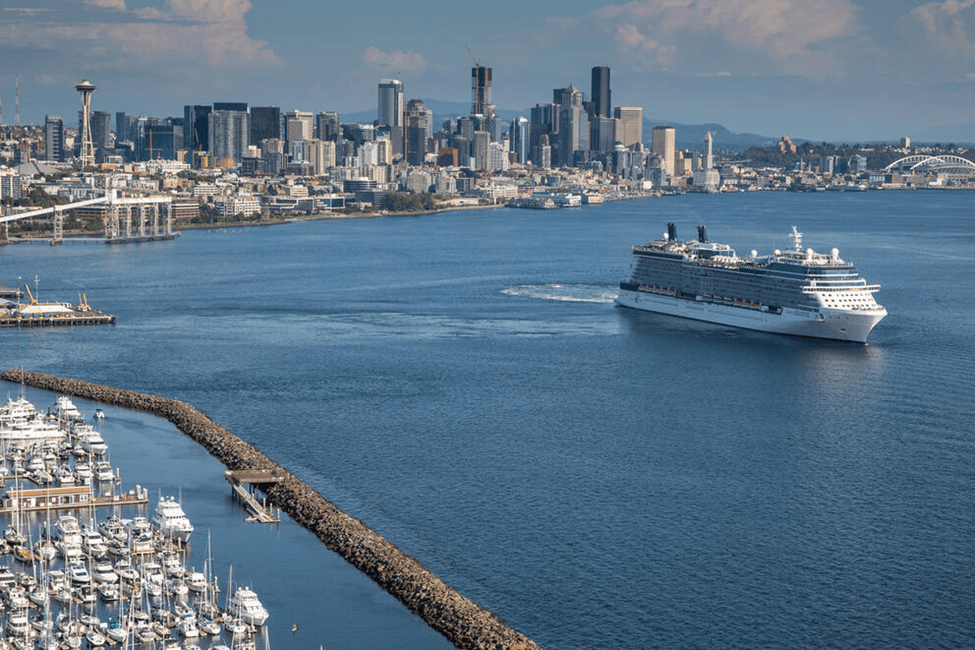
The Royal Caribbean Ovation of the Seas cruise ship leaves a port near Seattle. (Courtesy of the Port of Seattle)

Actually, the Green Corridor concept has been underway for some time.

Last May, the Pacific Coast Business Times reported the Port of Hueneme became the first U.S. port authority to sign agreements to create green automotive shipping corridors with ports and terminals in Japan and South Korea. “The partnerships we have with Japan and South Korea will help mutually grow commercial relationships with existing port clients and allow for a dynamic effort to make a difference around the globe with green shipping and development practices,” Kristin Decas, Port of Hueneme CEO and director, said in a press release.

The Port of Hueneme signed agreements to create green automotive shipping corridors between it and the Port of Yokohama in Japan and the Wallenius Wilhelmsen Pyeongtaek International Ro-Ro automotive terminal in the Port of Pyeongtaek, South Korea.

The agreements will help promote collaboration for environmentally sustainable port development initiatives and automotive logistics to transition to a zero-emission future, according to the release.

In September 2023, the Ports of Los Angeles, Long Beach, and Shanghai unveiled an Implementation Plan Outline for the first trans-Pacific green shipping corridor. Corridor features include:

  • A voluntary partnership of leading maritime goods movement stakeholders, including the Ports of Los Angeles, Long Beach, and Shanghai, with input from leading cargo owners, has developed a Green Shipping Corridor Implementation Plan Outline to accelerate emissions reductions on one of the world’s busiest container shipping routes. 
  • Plan development was supported by C40 Cities, the global network of mayors working to deliver the urgent action needed to confront the climate crisis. C40 is the facilitator of the Green Shipping Corridor, providing support to the cities, ports, and their corridor partners by coordinating, convening, facilitating, and providing communications support for the corridor’s goals.
  • Carrier partners supporting this plan intend to begin deploying reduced or zero lifecycle carbon capable ships on the corridor by 2025. 

X-Press Feeders, the world’s largest independent common carrier, recently signed a memorandum of understanding (MOU) with six European ports: Port of Antwerp Bruges (Belgium), Port of Tallinn (Estonia), Port of Helsinki (Finland), Port of Hamina Kotka (Finland), Freeport of Riga (Latvia) and Klaipeda Port (Lithuania). 

Through this MOU, X-Press Feeders and the participating ports will pool resources and expertise to develop and implement sustainable practices for maritime operations. 

Under the MOU: 

– Parties will work together to further develop infrastructure for the provision and bunkering of alternative fuels such as green methanol, 

– Encourage the development of supply chains for fuel that are zero or near zero in terms of greenhouse gas emissions 

– Provide further training programs for port workers and seafarers with regards to the handling of alternative fuels

– Leverage digital platforms to enhance port call optimization 

– Parties will have regular meetings to update and discuss progress on actions for further developing green shipping corridors. 

X-Press Feeders’ green methanol is sourced from fuel supplier OCI Global. The green methanol is made from green hydrogen and the decomposition of organic matter, such as waste and residues. OCI’s green methanol is independently certified by the International Sustainability and Carbon Certification (ISCC) Association headquartered in Germany. The ISCC system promotes and verifies the sustainable production of biomass, circular and bio-based materials and renewables.  

X-Press Feeders, which was founded in Singapore in 1972, is the world’s largest independent common carrier. X-Press Feeders operates a fleet of more than 100 vessels, calling at more than 180 ports worldwide. X-Press Feeders aims to achieve net zero emission by 2050 and be the ‘Greener Feeder Carrier of Choice’.

Green Shipping

Green shipping refers to transporting goods with as little environmental impact as possible. This may involve using advanced technology to optimize ship design, operations and performance to improve energy and fuel efficiency, prevent pollution, and reduce emissions. The concept of green shipping may be implemented already in the design phase of a new vessel, through continuous improvements or by switching to zero-emission fuels.

Switching to zero-emission fuels is gradually proceeding as more alternative fuels and engines enter the market. More shipbuilders are designing ships with green technology such as dual-fuel engines to accelerate the shift to clean fuels

Green shipping also includes training and educating staff and crew members in marine environmental awareness, including environmental policies, global requirements and compliances, ship energy efficiency, safe bunkering, oil transfer procedures, pollution prevention, garbage handling and disposal, biofouling, and ballast water management.

The International Maritime Organization (IMO) has set a target to reduce the total annual GHG emissions from international shipping by at least 50 percent by 2050. 

So, here’s the skinny on the latest green corridor, from the Port of Seattle.

The Pacific Northwest to Alaska Green Corridor (PNW2Alaska) is a collaboration among 14 organizations to create “a new era of low- and zero- greenhouse gas (GHG) emission cruise travel between Alaska, British Columbia and Washington.”

Decarbonizing this environmentally sensitive route is challenging, the port says. “Urban ports like Seattle and Vancouver can access large amounts of clean electricity to run shoreside operations and may have easier access to alternative fuels being developed. Smaller, remote ports in Alaska have more infrastructure and access challenges. Any decarbonization solution needs to work for cities, boroughs, ports, and cruise lines carrying passengers thousands of miles.”

The PNW2Alaska Green Corridor initiative considers the needs of each partner as it tests the feasibility of local solutions to decarbonize cruises in the Pacific Northwest. “One goal for all partners is that this first cruise-led Green Corridor can be an idea test bed that accelerates decarbonization at the 2,000 river and ocean cruise ports around the world.”

An aerial view of ships, boats, ferries and liners around Vancouver, B.C. (Courtesy of Vancouver Fraser Port Authority)

“No single group can achieve decarbonization. Combatting the reality of climate change takes honesty, accountability, innovation, and partnership,” said Port of Seattle Commission President Hamdi Mohamed of the collaboration. “We want to become a zero-emission port by 2050, and we need communities and industry partners to work together to meet these ambitious goals.”

PNW2Alaska was established in response to the 2021 Clydebank Declaration, a global commitment to create six green corridors on specific shipping routes by 2025, with corridors in operation by 2030, to move the needle toward maritime decarbonization at scale. Twenty-four countries took the commitment, the U.S. and Canada among them.

Next, Green Corridors, Part 2, and “elevating the future of freight.”

Maritime Partners, USCG agree on hydrogen power system

M/V Hydrogen One rendering. Credit: Elliott Bay Design Group

Maritime Partners received a ‘Design Basis Agreement’ from the U.S. Coast Guard for the M/V Hydrogen One towboat that includes e1 Marine hydrogen generator technology that will be used for the vessel’s power plant.

Maritime Partners, LLC, is a New Orleans-based maritime financing company that’s primarily focused on Jones Act vessels. The Maritime Partners press release said, “The M/V Hydrogen One is being designed as a first-of-its-kind vessel using new, cleaner, fuel cell technology that works by converting stored methanol to hydrogen.”

The hydrogen is then put into the fuel cell to generate power for the vessel. A successful string test of this technology was completed in Gothenburg, Sweden, in June 2023, proving it to be a viable option as the sole power generation source for vessel propulsion.

“The signing of this agreement opens the pathway for us to deploy our technological capabilities,” said Bick Brooks, co-founder and CEO of Maritime Partners. “With this, Hydrogen One is one step closer to becoming the world’s first vessel to utilize hydrogen generator technology greatly reducing emissions, increasing efficiency and providing a model for cleaner energy use as the industry continues to seek ways to decarbonize.”

The DBA process sets the rules for new technology proposed for installation on marine vessels. Maritime Partners worked with several industry leaders on the Hydrogen One project, including the Seattle-based Elliott Bay Design Group, which is designing the towboat; Bourg, La.-based Intracoastal Iron Works, which is the selected shipyard; e1 Marine, RIX Industries, Power Cell Group, among others, to work through the U.S. Coast Guard requirements.

Dave Lee, Maritime Partners’ VP of Technology & Innovation, said his company is committed to “developing and utilizing sustainable, clean energy solutions, as the entire maritime industry continues to seek alternative fuel options that are cleaner, greener, and more efficient.”

The signing of this DBA ensures that as the M/V Hydrogen One project advances Maritime Partners will be working towards an agreed-upon framework with the U.S. Coast Guard for the design, arrangement, and engineering aspects of the power system and associated safety systems for plan review, inspection, and eventual certification of the M/V Hydrogen One.

This is an important and necessary step for the eventual development of fossil-free marine propulsion.

An exercise in futility?

No More Fossil Fuels by Joe Brusky via Flick CC

Supply chain emissions are mostly “overlooked” by corporations measuring their operational emissions (known as Scope 1 and 2), leaving a huge question mark about the ability to achieve net zero globally by 2050.

That’s a major problem, as a report from Boston Consulting Group indicates: corporations’ “supply chain Scope 3 emissions are 26 times higher than their operational emissions.” And: “Supply Chain Scope 3 Emissions continue to be overlooked, with only 15% of corporates having set a supply chain emissions target.”

Looking at this another way, 85% of businesses have no commitment to cut supply chain emissions!

That undermines the entire net zero exercise and its timeline because those blind spots drive “significant unreported risks for both investors and corporates.”

The BCG analysis examined the climate disclosures made by more than 23,000 companies through CDP (the non-profit Carbon Disclosure Project) this year, which was slso produced in collaboration with Boston Consulting Group (BCG).

For the average large, listed company, supply chain emissions will be 26 times higher than those generated in operations. The discrepancy is even higher in the retail and apparel sectors, at a ratio of 92:1 tonnes and 47:1 tons respectively.

The only sector in which supply chain emissions are equal to or less than operational emissions is fossil fuels.

“As such, having a robust plan to cut supply chain emissions should be part of any corporate climate strategy,” notes BCG.

The report says its conclusions “highlight that the challenge of effectively measuring Scope 3 emissions is widespread and spans industries,” said Sonya Bhonsle, director of strategic accounts at CDP. “Meaningful strides toward emissions reductions require corporates to evaluate their full supply chain, then raise ambition and take accountability. The first step to driving meaningful change toward a 1.5°C-aligned net zero future begins with disclosure.”

Evaluating the spectrum of all emissions is challenging and might be an impossibility. Unless all facets of the drive to net zero are factored in – and not “overlooked” – net zero cannot be achieved.

But then what is Plan B?

Study Boosts Development of LA/LB to Singapore Green Shipping Corridor

Singapore by Sarah Lou via Flickr CC

A study conducted by the maritime classification society American Bureau of Shipping this month says a green and digital shipping corridor (GDSC) between Singapore, Los Angeles and Long Beach might create more than 700 jobs in zero- and near-zero emission fuel production by 2030.

The study, commissioned by Singapore’s Maritime & Port Authority (MPA) and the ports of Los Angeles and Long Beach, also found that the corridor could also lead to health improvements for local communities, as well as economic benefits for participating countries.

The Port of Singapore’s strategic location makes it “one of the busiest and leading container trans-shipment hubs, connecting Asian markets to more than 600 ports in over 120 countries around the world,” the study says. Meanwhile, the ports of Los Angeles and Long Beach are the leading U.S. gateways for trans-Pacific trade. “The trans-Pacific trade route between Singapore and Los Angeles/ Long Beach is a “critical enabler” of the strong economic relationship between Singapore and California.

According to APEC (Asia Pacific Economic Corporation), bilateral trade reached $10.344 billion in 2022, establishing Singapore as California’s 12th-largest trading partner. Additionally, California ranks as Singapore’s second-largest trading partner among all U.S. states, representing 13.3% of the national trade in Singapore.

According to the study, the ports of Singapore, Los Angeles and Long Beach already play a “significant role in maritime decarbonization.”

MPA wants to reduce emissions from port terminals by at least 60% from 2005 levels by 2030, and to achieve net zero by 2050. “MPA also aims to reduce absolute emissions from domestic harbor craft fleet by 15% from 2021 levels by 2030, and half the emissions from 2030-level by 2050.”

Singapore is developing various net-zero fuel pathways, including focusing on electrification and biofuels for domestic harbor crafts and building up the value chain for ammonia and methanol for international shipping.

The ports of LA and LB have signed green shipping corridor agreements with ports in Asia to deploy ships with full life cycle low or even zero carbon emission capabilities in this corridor. Since the announcement of the ZEERO (Zero Emissions, Energy Resilient Operation) commitment, Long Beach has invested $300 million in establishing a green fuel hub to cut carbon emissions by 91% since 2005. In 2023, The MPA, the ports of Los Angeles and  Long Beach, with the support of C40 Cities, established the Green and Digital Shipping Corridor (GDSC) to accelerate decarbonization of the maritime industry and the development and deployment of digital technology solutions and enablers

The study provides a baseline of activities and energy demand requirements for vessels operating on the corridor through 2050. The study estimates the quantity of near-zero and zero-emission fuels required for this traffic by modeling the adoption of zero and near-zero carbon alternative fuels by vessels operating on the corridor through 2050, considering various parameters such as fuel production costs and fuel availability, and in view of the targets in the 2023 International Maritime Organization’s Strategy on Reduction of Greenhouse Gas Emissions from Ships. (The study can be found at c40.me/3xF60Yw.)

“The Port of Long Beach and its partners have been very successful in reducing emissions from cargo-handling equipment, trucks and other mobile sources moving cargo in our harbor,” said Port of Long Beach CEO Mario Cordero. “One of the most important parts of this partnership is it allows us to better understand and target a source of emissions that is hard for us to control as a local seaport authority – shipborne emissions. This work, vital to our net zero-emission quest, will result in economic and health benefits all along the trans-Pacific trade corridor.”

“This study provides a sense of scale and scope to inform our implementation of the Green and Digital Shipping Corridor,” said Port of Los Angeles Executive Director Gene Seroka. “Achieving the reductions of greenhouse gas emissions required will take coordination and commitment from public and private stakeholders across the maritime and goods movement industries. We’re proud to be collaborating with industry partners to make this corridor a reality.”

A U.S. State Department fact sheet on the green corridor framework notes that green shipping corridors can “spur early and rapid adoption of fuels and technologies that, on a lifecycle basis, deliver low- and zero-emissions across the maritime sector, placing the sector on a pathway to full decarbonization.  

“The United States envisions green shipping corridors as maritime routes that showcase low- and zero-emission lifecycle fuels and technologies with the ambition to achieve zero greenhouse gas emissions across all aspects of the corridor in support of sector-wide decarbonization no later than 2050.” 

In a related green corridor development, X-Press Feeders, a large independent common carrier, has signed of a memorandum of understanding with six European ports: Port of Antwerp Bruges (Belgium), Port of Tallinn (Estonia), Port of Helsinki (Finland), Port of HaminaKotka (Finland), Freeport of Riga (Latvia) and Klaipeda Port (Lithuania). 

Through the MOU, X-Press Feeders and the participating ports will pool resources and expertise to develop and implement sustainable practices for maritime operations. 

The collaboration between the parties will begin with the establishment of these two shipping routes: 

Green Baltic X-PRESS (GBX): Rotterdam – Antwerp Bruges – Klaipeda – Riga – Rotterdam 

Green Finland X-PRESS (GFX): Rotterdam – Antwerp Bruges – Helsinki – Tallinn – HaminaKotka – Rotterdam 

These services are scheduled to begin in the third quarter of this year. This development is significant as these will be the very first scheduled feeder routes in Europe powered by green methanol, an alternative fuel that produces at least 60% less greenhouse gas emissions than conventional marine fuel. 

X-Press Feeders operates a fleet of more than 100 vessels, calling at more than 180 ports worldwide. X-Press Feeders aims to achieve net-zero emissions by 2050.

You can afford it!

Confusion and lack of clarity abounds when it comes to implementing a carbon tax and various decarbonization proposals and goals. It’s all a game: trying to avoid costs and even making money (at least breaking even) from emission trading systems.

Decarbonization by IRENA via Flickr CC

As one knowledgeable observer noted recently, “There is little to no appetite currently among beneficial cargo owners (BCOs) to pay up for decarbonized ocean container transport. There remains a wide variance in the emission trading system (ETS) surcharge estimates by carriers that illustrates the uncertainty over just how much the carbon tax will cost the industry.”

As Greg Knowler, Europe Editor at IHS Markit Maritime & Trade, relates in a LinkedIn post, Ocean carriers will need to comply with the European Union emissions trading system (ETS) from Jan. 1, 2024, a cap-and-trade principle that has been applied to industries in Europe since 2005 and was recently extended to cover shipping. His article continues:

“A cap is placed on the amount of CO2 that can be emitted by those within the system and companies must buy carbon allowances that cover their annual emissions. These allowances can be bought on the open carbon market or traded among companies.

“From Jan. 1, for every ton of CO2 emitted by a ship, the carrier will need to buy 1 emission allowance, called an EUA, from the carbon market. The regulation will be phased in according to a progressive schedule over the next two years. In 2024, carriers will be charged for 40% of all emissions, 70% in 2025 and 100% of emissions after 2026.

“Half of journeys that begin or end outside the EU will be covered by the ETS, and all the emissions from voyages between ports in the EU and while alongside will be covered.

“There are significant costs involved for carriers. According to emissions monitoring platform OceanScore, the maritime industry in 2022 generated CO2 emissions of 126 million tonnes from voyages to, from, between and within European ports. That would have resulted in the need to surrender 82.7 million EU Allowances (EUAs), or carbon credits, under the ETS, equating to a total cost of €6.5 billion based on the current price of €78 per EUA.  

“Hapag-Lloyd CEO Rolf Habben Jansen has estimated the ETS will cost Hapag-Lloyd $100 million in 2024, with that amount tripling in the next couple of years, and he has vowed to recover those costs from customers.”

Knowler quotes Jansen: “The initial cost is there, and we will not absorb the cost, It is real and is a fully out-of-pocket cost and people must accept it. We talk about $100 extra per container, and if you look at the value of the goods that are inside, people should be able to accept that.”

Knowler writes, “It will become harder and harder for the carriers to absorb the ETS costs as they get phased in, and as the free emission allowances across all industries gets phased out and compliance gets progressively more expensive…this is the way the system has been designed. The ETS is supposed to make it more expensive so those in the shipping industry are forced to use greener fuels and services to enable the European Union to be climate neutral by 2050.”

That last concluding bit is the point of this complicated and ultimately frustrating exercise. The bottom line is that no one wants to pay for the cost of climate change except those that can’t afford it. Climate change will exact its own high costs for everyone on this planet sooner or later.

The thing about net zero emissions and decarbonization is that while intentions are well meaning (or not) companies, especially those that use fossil fuels, don’t want to pay. God forbid that their margins and profits might decrease if they implement net zero net zero actions. Better to protect shareholders than the climate. It’s disgusting, shortsighted, and deadly,

This is the real bottom line: Do the right thing. Take the financial hit for the good of the planet! You can afford it!