UN Guide will help insurers plan for net-zero transition

Solar on net-zero house. Credit: David Dodge, Green Energy Futures via Flickr CC

The United Nations published a guide designed to help insurers plan for the transition to net zero.

On 2 July, the UN convened a multistakeholder “Forum for Insurance Transition to Net Zero (FIT)”, saying the guide is tailored for insurance and reinsurance underwriting portfolios. “This new deep-dive global guide was presented at the inaugural FIT Transition Insurance Summit hosted by the European Insurance and Occupational Pensions Authority (EIOPA) at their headquarters in Frankfurt, Germany.”

According to a Green Central Banking article, “The impact of climate change on insurance markets has been systematically underestimated, with profound implications for financial stability and the sustainability of the risk-sharing services insurance companies provide.

“The European Central Bank warned in June that insurers are at increasing risk from the physical risks of climate change, which could become a source of systemic risk.”

The UN described FIT as follows: “Underwriting the Transition” provides insurance market participants—insurers, reinsurers and brokers—with a comprehensive and structured framework to help them develop and disclose credible transition plans for underwriting portfolios, addressing a significant gap in existing transition plan guidance for the insurance industry.

“This pioneering guide paves the way for insurers, reinsurers and brokers to move beyond high-level commitments by independently implementing robust and actionable strategies that enhance long-term business resilience and company value, and help achieve global sustainability goals,” said Butch Bacani, UNEP Head of Insurance and FIT Chair. By underwriting with foresight, and by accelerating and scaling up a just transition to a resilient net-zero economy, the insurance industry can lead with purpose and conviction in helping build inclusive, resilient and sustainable communities and economies, and reaffirm its role as society’s risk manager.”

“Underwriting the Transition identifies key elements of a credible transition plan and provides a checklist to assess the credibility of a transition plan. Through real-world examples, the guide demonstrates how leading insurers, reinsurers and brokers are each implementing various concepts and approaches in their underwriting portfolios that support a just transition to a resilient net-zero economy, as shared in their published transition plans. Moreover, it helps insurance market participants navigate a complex and evolving landscape of sustainability disclosure and reporting.

“It is the second deliverable of the FIT Transition Plan Project—a series of global guidance to address the current major gap in insurance-specific transition plan guidance. “Underwriting the Transition” builds on the FIT’s inaugural report, “Closing the Gap: The emerging global agenda of transition plans and the need for insurance-specific guidance”, which was launched at the 2024 UN Climate Conference (COP29) in Baku, Azerbaijan.”

The third and final FIT Transition Plan Project publication will produce holistic, “total balance sheet” transition plan guidance that links the underwriting and investment portfolios of insurance and reinsurance companies. It is scheduled to be launched at the 2025 UN Climate Conference (COP30) in Belém, Brazil this November.

At the COP29 launch event of the FIT’s inaugural report, Dyogo Oliveira, President of the Brazilian Insurance Confederation (CNseg), announced that CNseg has joined the FIT, and that CNseg will build a “House of Insurance” at COP30, which will serve as the main platform for climate ambition and action by the global insurance industry.

“As COP30 approaches, we look forward to working together with the Brazilian insurance industry, the wider insurance, regulatory and supervisory community, and key stakeholders—from policymakers and real economy actors; to the scientific and academic community, and civil society—and to making the ‘House of Insurance’ a symbol of inclusiveness, resilience, sustainability, and hope,” said Bacani.

Chaired by the United Nations Environment Programme (UNEP), the FIT currently comprises over 50 organizations from across the globe.

UNEP saif FIT “continues to deepen and strengthen its commitment to work with the global insurance industry and key stakeholders to support the acceleration and scaling up of a just transition to a resilient net-zero economy as part of the solution to the triple planetary crisis of climate change, nature loss, and pollution; and the vision of a resilient, sustainable, and prosperous future for all.”

Related recent climate change reading:
Reuters: World risks up to $39 trillion in economic losses from vanishing wetlands, report says  
World Economic Forum: Why we must roll out multiple energy transition solutions to reach net zero. https://www.weforum.org/stories/2025/07/multiple-energy-transition-solutions-to-hit-net-zero/   The Guardian: Politicians are retreating from net zero because they think the public doesn’t care. But they’re wrong.  https://www.theguardian.com/commentisfree/2025/jul/07/politicians-net-zero-public-research-climate-crisis  Rebecca Willis  
 

Impact of Trump’s NCA Dismissals: A Scientific Response

Road to Nowhere by Renate via Flickr CC

US science organizations to pick up on Trump’s abandonment of NCA

Two major US scientific organizations, American Meteorological Society and American Geophysical Union, will work together to produce more than 29 peer-reviewed journals covering all aspects of climate change, including observations, projections, impacts, risks and solutions.

The AP and the Guardian reported on the development late last week after the Trump administration dismissed all contributors to the sixth National Climate Assessment (NCA), the US government’s major study on climate change. The dismissal of nearly 400 contributors left the future of the study in doubt; it had been scheduled for publication in 2028.

The NCA has been overseen by the NASA-supported Global Change Research Program, a US climate body that the Trump administration also dismissed last month. The reports, published since 2000, coordinated input from 14 federal agencies and hundreds of scientists.

Speaking to the Associated Press, Katharine Hayhoe, a Texas Tech University climate professor and chief scientist at The Nature Conservancy, said the collaboration between AMS and AGU “is a testament to how important it is that the latest science be summarized and available.”

Hayhoe, who was a lead author of reports in 2009, 2018 and an author of the one in 2023, added: “People are not aware of how climate change is impacting the decisions that they are making today, whether it’s the size of the storm sewer pipes they’re installing, whether it is the expansion of the flood zone where people are building, whether it is the increases in extreme heat.”

In addition to widespread dismissals across federal agencies, federal websites have been purged of information pertaining to climate change and extreme weather events since Trump took office in January.

The NCA report is required by a 1990 federal law and was due out around 2027. Preliminary budget documents show slashed funding or elimination of offices involved in coordinating thereport, scientists and activists said in an AP report.

“We are filling in a gap in the scientific process,” AGU President Brandon Jones said. “It’s more about ensuring that science continues.”

Meteorological society past president Anjuli Bamzi, a retired federal atmospheric scientist who has worked on previous National Climate Assessments, said one of the most important parts of the federal report is that it projects 25 and 100 years into the future.

With the assessment, “We’re better equipped to deal with the future,” Bamzi said. “We can’t be an ostrich and put our head in the sand and let it go.”

In the announcement on Friday, the two societies said: “This effort aims to sustain the momentum of the sixth National Climate Assessment (NCA), the authors and staff of which were dismissed earlier this week by the Trump administration, almost a year into the process.”

According to the AMS and AGU, the collection will not replace the NCA but instead create a mechanism for important work on climate change’s impact to continue.

“It’s incumbent on us to ensure our communities, our neighbors, our children are all protected and prepared for the mounting risks of climate change,” AGU’s president, Brandon Jones, said.

“This collaboration provides a critical pathway for a wide range of researchers to come together and provide the science needed to support the global enterprise pursuing solutions to climate change,” he added.

Similarly, the AMS president, David Stensrud, said: “Our economy, our health, our society are all climate-dependent. While we cannot replace the NCA, we at AMS see it as vital to support and help expand this collaborative scientific effort for the benefit of the US public and the world at large.”

The last climate assessment report, released in 2023, said that climate change is “harming physical, mental, spiritual, and community health and well-being through the increasing frequency and intensity of extreme events, increasing cases of infectious and vector-borne diseases, and declines in food and water quality and security.”

In 2018, during Trump’s first term, the assessment was just as blunt, saying: “Climate change creates new risks and exacerbates existing vulnerabilities in communities across the United States, presenting growing challenges to human health and safety, quality of life, and the rate of economic growth.”

Is this the start of push-back on Trump? If so, Yes!

Related reading (from AP):

The world’s biggest companies have caused $28 trillion in climate damage, a new study stimates.

Trump’s push to save fading coal industry gets warm West Virginia embraceEPA announces broad reorganization that includes shuffle of scientific research

A world without birds?

Sulphur Crested Cokatoo by Bernard via Flickr CC

Unimaginable…but a Clemson University study concludes that climate is changing faster than most of the world’s birds can adapt.

Casey Youngflesh, an assistant professor in Clemson University’s Department of Biological Sciences, led a study at the university that examined how a bird’s pace of life — the rate at which it grows, develops, reproduces, and how long it lives — is related to environmental conditions and what that reveals about how they might respond to a changing climate.

Included in the study were 7,477 species of birds — basically all the world’s resident, non-marine birds — and used global climate data from 1950 to 2022.

Youngflesh and collaborators from Michigan State University “found that a key link exists between how much an environment varies over time and how long birds tend to live,” according to an article by Cindy Landrum of Clemson’s College of Sciences. “Specifically, species tend to live longer in environments that are more variable from year-to-year, a type of bet-hedging strategy that has long been theorized.”

These longer-lived species “may be at greater risk as well. All else being equal, these species experience greater change per generation than their shorter-lived counterparts. Because more generations means faster adaptation potential, these species are more likely to lag behind in their response to climate change.”

“One of the key things that varies among different bird species is pace of life. We were specifically interested in the role of the environment in potentially driving those differences,” Youngflesh said. “Where do we see ‘slow species’? Where do we see ‘fast species’? And why?”

The study found that birds with a “fast” pace of life have shorter lifespans and have as many young as they can during that time, something Youngflesh called a “live fast, die young” strategy. Birds with a “slow” pace of life have longer lifespans and low rates of reproduction. 

“For a ‘slow’ species, if one year is bad, you’re going to live on to reproduce another year —you’re waiting it out. If you’re a bird that lives 30 years, you could handle a couple of bad years,” he said. “But if you’re a ‘fast’ species and there are several bad years in a row, that might be catastrophic. They may not get an opportunity to breed and raise their young.”

These results have important implications for understanding how species are likely to respond  to climate change. 

“While organisms with a slower pace of life (longer lifepans) are expected to be more robust to environmental variability, these species will tend to adapt to directional change at a slower rate. Fewer generations over a given period means fewer opportunities for selection to operate and thus slower evolutionary adaptation. Similarly, for a species that is used to large fluctuations in temperature year-to-year, a small change in temperature might be less meaningful than to a species that experiences very little fluctuation in temperature over time.”

S0, all change is not equal: “A one-degree Celsius change in temperature is not equal in all environments,” Youngflesh said. “We are making the case that we need to contextualize rates of climate change in terms of both the historical variability of environmental systems and species’ pace of life.”

The study compared two birds: a sulphur-crested cockatoo, which had the longest generation length of any species in the study at 27.2 years, and the double-barred finch, which had the shortest generation length at 1.4 years.

“There might be 19 generations of double-barred finch for every one generation of sulphur-crested cockatoo,” Youngflesh said. “So, the sulphur-crested cockatoo has fewer opportunities for selection to operate and thus slower evolutionary adaptation, all else being equal. Species experiencing higher rates of environmental change per generation are likely to be those that suffer the greatest consequences of climate change.

Detailed findings were published in Ecology Letters in an article titled, “Environmental variability shapes life history of the World’s birds.”

Green Corridors: Enhancing Cross-Border Freight Efficiency

Green Corridors’ GC-IFTS (Green Corridors Intelligent Freight Transportation System) “offers a solution at Port Laredo that will benefit future generations by reducing congestion, bypassing gridlocked areas, and increasing border security.” (Photo credit: Green Corridors.)

Last time, I talked about a Port of Seattle green corridor for cruises to Alaska, along with other port corridors, In this space I will look at the aptly named Green Corridors, a land-based infrastructure freight corridor using elevated tracks.

Green Corridors is an ambitious undertaking that uses technology to bypass traffic congestion by implementing “state-of-the-art, low-emission shuttles traveling on elevated guideways.”  The thinking is to remove traffic congestion by moving freight off the road and onto elevated guideways, “resulting in increased efficiency, sustainability, security and road safety.”

Green Corridors, based in Austin, Texas, offers the logistics industry innovative freight transportation services by moving semi-truck trailers and sea containers across international borders, between a seaport and an inland terminal or through key trade corridors. Designed for transportation providers, port authority and terminal operators, logistics companies will book freight directly on Green Corridors’ system.

Green Corridors’ technology includes automated inland terminals, autonomous freight shuttles, and elevated guideway infrastructure. Inland terminals will serve as hubs for commerce and logistics services.  The cost of such a project is unclear. The company says it is on a mission to improve the $300 billion international trade corridor between Laredo, Texas to Monterrey, N.L., Mexico.

According to a Mexico Business News article, published last year, the Government of Nuevo Leon and Green Corridors signed a Memorandum of Understanding (MoU) to revamp commercial corridors by integrating sustainable technologies that aim to enhance efficiency in cross-border transportation management.

During his visit to Austin, Texas, Governor of Nuevo Leon Samuel García was introduced to the project by executives from Green Corridors.

The MoU, signed by García and Mitch Carlson, CEO, Green Corridors, established a collaborative link to build a Comprehensive Intelligent Freight Transportation System (IFTS) from the Colombia-Laredo area to the Monterrey Metropolitan Zone. This system will facilitate point-to-point cargo transportation within the region, “ultimately reducing traffic congestion and boosting operational efficiency in goods movement.”

Both Green Corridors and the Government of Nuevo Leon want to develop and implement new technologies and operational methods to enhance the efficiency of cross-border and domestic freight transportation.

“The Green Corridors solution encompasses two initial projects applicable to various Ports of Entry (POEs): Seaport to Inland Terminal, and Land Border Crossing. These projects aim to mitigate congestion and security concerns at border crossings and waterfront sites by relocating freight to strategically located areas,” the article said.

One such project involves the Port of Houston, which anticipates a 75% increase in cargo volumes by 2035. This growth is also expected to exacerbate congestion and emissions, leading to supply chain bottlenecks and increased air pollution. To address these challenges, the Green Corridors Initiative (GCI) has been launched in collaboration with stakeholders such as the Port of Houston, Texas Department of Transportation (TxDOT), and Texas A&M University.  Mexico Business News says:

“The project at the Port of Houston aims to reduce traffic congestion, emissions, and road maintenance costs, while improving supply chain resilience and air quality. The project aims to have 1.52 million truck trips removed from the road per year, reducing carbon emissions by 472,623t annually. These changes will also avoid replacing 123,974 tires per year and save US$153.12 million in fuel and 36.9 million gallons of diesel.

“On the other hand, the Green Corridors project in El Paso-Juarez aims to facilitate the movement of trucks through the border region, contributing to regional economic development and job creation. The port is expected to handle a significant portion of future truck traffic. Thus, this project promises substantial reductions in emissions, fuel consumption, and truck trips.”

E#arly days, but it could be part of the freight solution.

Heating up, drying up

Global warming by Howard Duncanvia Flickr CC

Last year was yet another “warmest on record”  according to a UVA Today article (my alma mater, but multiple sources reported this) —warmest year on record in 2024. The UVA article cited data from the European Union’s Copernicus Climate Change Service, Europe’s leading environmental monitoring program, and a handy site to follow..

Sadly, last year was the first to exceed the 1.5 degrees Celsius (2.7 F) red line above the pre-industrial average set by the 2015 Paris Agreement, the treaty that aims to reduce deal with climate change.

“2023 was roughly 0.3 degrees Celsius (0.5 F) warmer than 2022,” said Kevin Grise, an associate professor of environmental sciences at the University of Virginia, “and 2024 continued that trend of being warmer than the previous year.”

Grise continued: “We’ve seen some unusual events that have huge impacts on ecosystems in the ocean and tropical systems. We saw the first ever Category 5 hurricane in the Atlantic basin in June, and we saw (Hurricane) Milton hit Florida, which rapidly intensified within 24 hours – an almost 95 mph intensification.”

The United Nations Climate Change Conference, held in Baku, Azerbaijan in November, focused on climate finance, with developed nations pledging to pony up at least $300 billion per year by 2035, triple the previous goal of $100 billion.

“From a policy perspective, the choices now are to focus now on climate mitigation and working to stop the emissions that are causing climate change or developing ways to adapt to a warmer world,” Grise said. “Or a combination of the two.”

Big numbers but not enough.

Also sadly, regarding climate finance, Wells Fargo recently withdrew from the Net Zero Banking Alliance (NZBA) without explanation. Kaleigh Harrison, writing in Environment+Energy Leader, said, “The decision was announced on a Friday afternoon, ahead of a holiday week, echoing a similar exit by Goldman Sachs just two weeks earlier. Despite initially joining the alliance in 2021 when it was politically advantageous, major U.S. banks have failed to align their fossil fuel financing with the goals of Net Zero emissions and a 1.5˚C climate pathway.”

She added: “Wells Fargo’s departure from the alliance highlights a broader trend of banks backtracking on voluntary climate commitments while continuing to finance fossil fuel expansion. Since the 2015 Paris Agreement, Wells Fargo has financed $296 billion in fossil fuel projects, including $99 billion for companies driving expansion in the sector. In 2023 alone, the bank funneled $11 billion into fossil fuel projects, according to data from Rainforest Action Network (RAN).”

Quite a start to 2025: it’s getting hotter, and the big bucks needed from organizations to combat climate change is drying up.

Hanford going solar

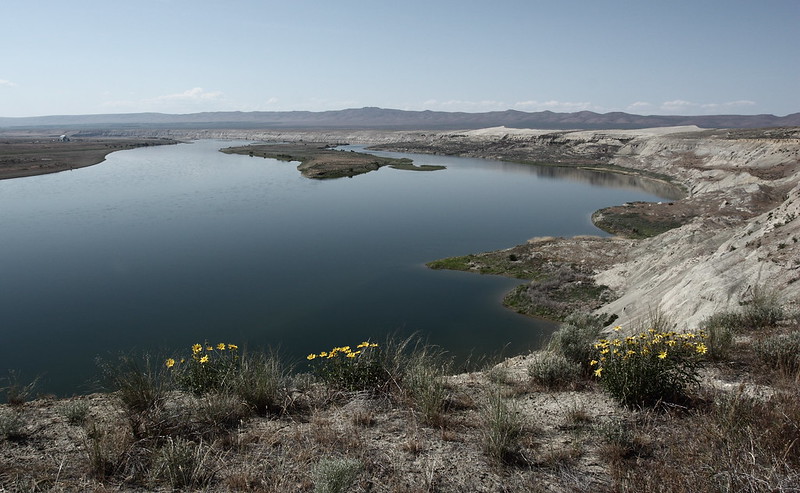
Hanford by Nicholas Blumhardt vi Flickr CC

The Department of Energy (DOE) entered into negotiations with Hecate Energy, LLC for a solar project capable of delivering up to one gigawatt of clean energy within an 8,000-acre area of DOE-owned land at the Hanford nuclear site as part of the Cleanup to Clean Energy initiative.

The Hanford site is a decommissioned nuclear production complex operated by the United States government on the Columbia River in Washington. It has also been known as Site W and the Hanford Nuclear Reservation. Established in 1943 as part of the Manhattan Project, the site was home to the Hanford Engineer Works and B Reactor, the first full-scale plutonium production reactor in the world. Plutonium manufactured at the site was used in the first atomic bomb, which was tested in the Trinity nuclear test, and in the Fat Man bomb used in the bombing of Nagasaki. For more Hanford’s history, click here.

DOE says the Cleanup to Clean Energy initiative aims to repurpose parts of DOE-owned lands to support the growth of America’s clean energy economy. The latest announcement reinforces the Biden-Harris Administration’s “whole-of-government approach to leveraging federal properties to increase the deployment of clean power through the buildout of utility-scale clean energy projects.”   

Secretary of Energy Jennifer M. Granholm said,  “Since the beginning of the Biden-Harris Administration, we’ve added nearly 90 gigawatts of solar capacity to the grid—enough to power roughly 13 million homes—and we’re building on this historic progress with another massive solar project,” She added that through this latest announcement,  DOE is transforming thousands of acres of land at the Hanford site into a thriving center of carbon-free solar power generation.”

Hecate Energy, LLC was selected to negotiate a real estate agreement for up to 8,000 acres at Hanford that DOE is making available for the development of a gigawatt-scale solar photovoltaic system with battery storage.

The selection was made through a competitive qualifications-based process for evaluating and ranking proposals. The selection comes after public comments on a request for information in August 2023, a Cleanup to Clean Energy information day at Hanford in September 2023, and a request for qualifications issued in March 2024. DOE and Hecate Energy will negotiate a realty agreement; DOE may cancel negotiations and rescind the selection for any reason during this process.

While cleanup at the huge Hanford site could take 50 years, the solar project might be up and running in five to seven years.

In addition to supporting the Administration’s clean energy goals, this project has the potential to benefit the Hanford site, Tribal Nations, and surrounding communities, while complementing local efforts to plan for the future. DOE will complete environmental review and applicable regulatory processes, and continue to communicate and partner with industry, Tribal Nations, communities, stakeholders, regulators, and others as clean energy projects are developed on DOE land. 

More information on the Cleanup to Clean Energy initiative can be found here

An exercise in futility?

No More Fossil Fuels by Joe Brusky via Flick CC

Supply chain emissions are mostly “overlooked” by corporations measuring their operational emissions (known as Scope 1 and 2), leaving a huge question mark about the ability to achieve net zero globally by 2050.

That’s a major problem, as a report from Boston Consulting Group indicates: corporations’ “supply chain Scope 3 emissions are 26 times higher than their operational emissions.” And: “Supply Chain Scope 3 Emissions continue to be overlooked, with only 15% of corporates having set a supply chain emissions target.”

Looking at this another way, 85% of businesses have no commitment to cut supply chain emissions!

That undermines the entire net zero exercise and its timeline because those blind spots drive “significant unreported risks for both investors and corporates.”

The BCG analysis examined the climate disclosures made by more than 23,000 companies through CDP (the non-profit Carbon Disclosure Project) this year, which was slso produced in collaboration with Boston Consulting Group (BCG).

For the average large, listed company, supply chain emissions will be 26 times higher than those generated in operations. The discrepancy is even higher in the retail and apparel sectors, at a ratio of 92:1 tonnes and 47:1 tons respectively.

The only sector in which supply chain emissions are equal to or less than operational emissions is fossil fuels.

“As such, having a robust plan to cut supply chain emissions should be part of any corporate climate strategy,” notes BCG.

The report says its conclusions “highlight that the challenge of effectively measuring Scope 3 emissions is widespread and spans industries,” said Sonya Bhonsle, director of strategic accounts at CDP. “Meaningful strides toward emissions reductions require corporates to evaluate their full supply chain, then raise ambition and take accountability. The first step to driving meaningful change toward a 1.5°C-aligned net zero future begins with disclosure.”

Evaluating the spectrum of all emissions is challenging and might be an impossibility. Unless all facets of the drive to net zero are factored in – and not “overlooked” – net zero cannot be achieved.

But then what is Plan B?

Study Boosts Development of LA/LB to Singapore Green Shipping Corridor

Singapore by Sarah Lou via Flickr CC

A study conducted by the maritime classification society American Bureau of Shipping this month says a green and digital shipping corridor (GDSC) between Singapore, Los Angeles and Long Beach might create more than 700 jobs in zero- and near-zero emission fuel production by 2030.

The study, commissioned by Singapore’s Maritime & Port Authority (MPA) and the ports of Los Angeles and Long Beach, also found that the corridor could also lead to health improvements for local communities, as well as economic benefits for participating countries.

The Port of Singapore’s strategic location makes it “one of the busiest and leading container trans-shipment hubs, connecting Asian markets to more than 600 ports in over 120 countries around the world,” the study says. Meanwhile, the ports of Los Angeles and Long Beach are the leading U.S. gateways for trans-Pacific trade. “The trans-Pacific trade route between Singapore and Los Angeles/ Long Beach is a “critical enabler” of the strong economic relationship between Singapore and California.

According to APEC (Asia Pacific Economic Corporation), bilateral trade reached $10.344 billion in 2022, establishing Singapore as California’s 12th-largest trading partner. Additionally, California ranks as Singapore’s second-largest trading partner among all U.S. states, representing 13.3% of the national trade in Singapore.

According to the study, the ports of Singapore, Los Angeles and Long Beach already play a “significant role in maritime decarbonization.”

MPA wants to reduce emissions from port terminals by at least 60% from 2005 levels by 2030, and to achieve net zero by 2050. “MPA also aims to reduce absolute emissions from domestic harbor craft fleet by 15% from 2021 levels by 2030, and half the emissions from 2030-level by 2050.”

Singapore is developing various net-zero fuel pathways, including focusing on electrification and biofuels for domestic harbor crafts and building up the value chain for ammonia and methanol for international shipping.

The ports of LA and LB have signed green shipping corridor agreements with ports in Asia to deploy ships with full life cycle low or even zero carbon emission capabilities in this corridor. Since the announcement of the ZEERO (Zero Emissions, Energy Resilient Operation) commitment, Long Beach has invested $300 million in establishing a green fuel hub to cut carbon emissions by 91% since 2005. In 2023, The MPA, the ports of Los Angeles and  Long Beach, with the support of C40 Cities, established the Green and Digital Shipping Corridor (GDSC) to accelerate decarbonization of the maritime industry and the development and deployment of digital technology solutions and enablers

The study provides a baseline of activities and energy demand requirements for vessels operating on the corridor through 2050. The study estimates the quantity of near-zero and zero-emission fuels required for this traffic by modeling the adoption of zero and near-zero carbon alternative fuels by vessels operating on the corridor through 2050, considering various parameters such as fuel production costs and fuel availability, and in view of the targets in the 2023 International Maritime Organization’s Strategy on Reduction of Greenhouse Gas Emissions from Ships. (The study can be found at c40.me/3xF60Yw.)

“The Port of Long Beach and its partners have been very successful in reducing emissions from cargo-handling equipment, trucks and other mobile sources moving cargo in our harbor,” said Port of Long Beach CEO Mario Cordero. “One of the most important parts of this partnership is it allows us to better understand and target a source of emissions that is hard for us to control as a local seaport authority – shipborne emissions. This work, vital to our net zero-emission quest, will result in economic and health benefits all along the trans-Pacific trade corridor.”

“This study provides a sense of scale and scope to inform our implementation of the Green and Digital Shipping Corridor,” said Port of Los Angeles Executive Director Gene Seroka. “Achieving the reductions of greenhouse gas emissions required will take coordination and commitment from public and private stakeholders across the maritime and goods movement industries. We’re proud to be collaborating with industry partners to make this corridor a reality.”

A U.S. State Department fact sheet on the green corridor framework notes that green shipping corridors can “spur early and rapid adoption of fuels and technologies that, on a lifecycle basis, deliver low- and zero-emissions across the maritime sector, placing the sector on a pathway to full decarbonization.  

“The United States envisions green shipping corridors as maritime routes that showcase low- and zero-emission lifecycle fuels and technologies with the ambition to achieve zero greenhouse gas emissions across all aspects of the corridor in support of sector-wide decarbonization no later than 2050.” 

In a related green corridor development, X-Press Feeders, a large independent common carrier, has signed of a memorandum of understanding with six European ports: Port of Antwerp Bruges (Belgium), Port of Tallinn (Estonia), Port of Helsinki (Finland), Port of HaminaKotka (Finland), Freeport of Riga (Latvia) and Klaipeda Port (Lithuania). 

Through the MOU, X-Press Feeders and the participating ports will pool resources and expertise to develop and implement sustainable practices for maritime operations. 

The collaboration between the parties will begin with the establishment of these two shipping routes: 

Green Baltic X-PRESS (GBX): Rotterdam – Antwerp Bruges – Klaipeda – Riga – Rotterdam 

Green Finland X-PRESS (GFX): Rotterdam – Antwerp Bruges – Helsinki – Tallinn – HaminaKotka – Rotterdam 

These services are scheduled to begin in the third quarter of this year. This development is significant as these will be the very first scheduled feeder routes in Europe powered by green methanol, an alternative fuel that produces at least 60% less greenhouse gas emissions than conventional marine fuel. 

X-Press Feeders operates a fleet of more than 100 vessels, calling at more than 180 ports worldwide. X-Press Feeders aims to achieve net-zero emissions by 2050.

All over the map

Climate Change by Taymaz Valley via Flickr CC

What to make of net zero? Is it really happening? Is it possible? Will there be enough money? Is there enough staying power on the part of companies and organizations? When?

One recent World Bank report,  Net Zero Energy by 2060: Charting Europe and Central Asia’s Journey Toward Sustainable Energy Futures, says that with decisive action, net zero energy is within reach in Europe and Central Asia (ECA). “The World Bank has developed a model to project an optimal least-cost pathway for ECA to achieve a net zero energy target by 2060. Together, the 23 countries included in the model produce almost a tenth of global greenhouse gas emissions. The report considers the profound impact the war in Ukraine has had on energy security by representing energy trade flows on the basis of gas pipeline flows and capacities as of May 2023 and under a stress test. This novel analysis delivers insights not covered by previous works, focused mainly on the European Union.” Continuing, in the short term, “Central Asia faces a tightening gas supply balance and some difficult choices. Central Asia has been a large net exporter of gas, notably to China. Rapidly growing demand within the entire subregion, combined with stagnating production (especially in Kazakhstan and Uzbekistan), limits the ability to meet export commitments to China and peak winter demand at home simultaneously. Russia’s proposed gas union with Kazakhstan and Uzbekistan could improve Central Asia’s natural gas balance, although the poor state of pipeline infrastructure (IEA 2016) poses uncertainties. Improving regional gas trade in Central Asia and increasing gas imports from Turkmenistan could be also used to replace coal in Kazakhstan, fill the emerging supply gap in Uzbekistan, and meet growing demand across Central Asia.”

So basically, it’s time for ECA to ditch fossil fuels and embrace renewables for energy security and sustainable growth. It sounds easy enough, but it’s complicated. Very complicated

Another recent report, an article in RealClear World, says Net Zero’s days are “numbered.” Former IMF chief economist Oliver Blanchard poured water on the claim that net zero is a major growth opportunity when he told the House of Lords Economic Affairs Committee that there would be a “substantial fiscal cost to achieve anything close to Net Zero.”

Of course, it’s going to be expensive, and no one really knows how costly it will be! Is it, as some say, a growth opportunity that will pay for itself? That would be nice, but that is probably way too optimistic.

For example, a recent analysis revealed that the world is not on course to achieve the target of zero-emission fuels comprising five percent of international shipping fuels by 2030, according to Reuters. This shortfall threatens the shipping industry’s broader objective of decarbonizing by 2050. The assessment indicates that the existing production capacity for scalable zero-emission fuels (SZEF) will only cover a quarter of the required fuel volume by 2030. As of the end of 2022, there were 24 ships capable of operating on SZEF, primarily methanol, with an additional 144 on order.

However, current orders represent only one-fifth of the necessary volume to achieve mid-term sustainability goals. “It’s just not enough at scale or at the pace that is needed,” said UN COP Climate Champions shipping lead Kathryn Palmer.

And here is a wild one: An article in Fortune says, “Germany’s latest ‘net zero’ plan involves storing carbon dioxide underground beneath the sea.” Wait, what? “According to the article, Germany plans to enable underground carbon storage at offshore sites, pushing ahead with a much-discussed technology in an acknowledgment that time is running out to combat climate change,” the country’s vice chancellor said. How difficult and expensive will that be?

Yes, but what happens if the globe somehow reaches net zero? That’s a big if, of course, because there is so much work to do by companies, organizations, and governments.

A recent paper from a group of scientists, published by Frontiers in Science, “The Zero Emissions Commitment and Climate Stabilization,” has some unnerving conclusions, including this one: “How confident are we that when we stop carbon emissions, we also stop global warming?” Yikes, there’s an enigma.

Here are some “key points” in the paper:

  • Substantial uncertainty remains in both the sign and magnitude of the Zero Emissions Commitment (ZEC): the expected additional change in global surface temperature once we achieve net zero CO2 emissions.
  • Uncertainty in ZEC has implications for the remaining carbon budget to stay below the temperature limits of the Paris Agreement: a positive ZEC reduces the remaining budget; a negative ZEC opens the door for more ambitious targets or more time to reach net zero.
  • The prospect of additional warming after net zero is both plausible and significant, with a chance that ZEC could exceed 15% of total global warming.
  • While a ZEC of 0 means no further change to global surface temperatures, other aspects of the Earth system, such as sea levels, will continue to change in a net zero world due to warming realized previously. These changes should be factored into the assessment of safe warming limits and adaptation plans.
  • Current climate models do not adequately represent the full scope of complex and interdependent Earth system processes that determine ZEC. (bold added)

The paper presents “a structure for quantifying uncertainty in ZEC and proposes a roadmap for future research into quantifying ZEC and reducing its uncertainties.

Uncertainly, thy name is net zero.

The sponge knows?

               Sponge by Olly Clarke via Flickr CC

Perhaps it should be net-below-zero. 

According to a study in Nature, the planet has already passed the 1.5 °C warming threshold that climate crisis experts are saying is the goal for climate action.

At the 2015 Paris Climate Accords, nations agreed not to exceed 1.5 °C, a main guardrail of climate change. But the problem is that the planet has already passed 1.5 °C of warming, according to a new measuring technique that goes back further in time than current methods. The technique involves dating ancient sponges.

“We have an alternate record of global warming,” said coral-reef geochemist Malcolm McCulloch, at the University of West Australia Oceans Institute in Crawley, and lead author of the study. “It looks like temperatures were underestimated by about half a degree.”

However, McCulloch says that long-lived marine sponges can provide indications of temperature as far back as the eighteenth century. He and his colleagues analyzed the ratio of the elements strontium to calcium in the 300-year-old calcium carbonate skeletons of a coral-like species of sponge, Ceratoporella nicholsoni, that grows off the coasts of Puerto Rico. This ratio changes only with changes in water temperature, making it a sort of thermometer, according to the study published in Nature Climate Change.

The sponges were sampled from one particular section in the Caribbean — the only place where they are found. They were collected at a depth of 33–91 meters, in what’s called the ocean mixed layer. “Sea-surface temperature can be highly variable on top,” McCulloch was quoted as saying. “But this mixed layer represents the whole system down to a couple hundred meters, and it’s in equilibrium with the temperatures in the atmosphere.”

The sponge skeletons suggest that the planet started to warm up in the mid-1860s, during the period currently defined as the pre-industrial baseline.

“The baseline is where we measure our current temperatures from, so when we say 1.5 [degrees of warming], it’s to do with this reference point,” said McCulloch.

McCulloch and colleagues have calculated that global temperatures had in fact increased by 0.5 °C more than what was estimated by the IPCC. “That’s a huge difference relative to the total amount of warming,” says McCulloch. Furthermore, the planet exceeded 1.5 °C of warming by around 2010–2012 and is on track to surpass 2 °C in the next few years.

Climate change is all about calibration and constantly trying to catch up; our planet operates on its own time schedule, no matter how hard we try to understand.