
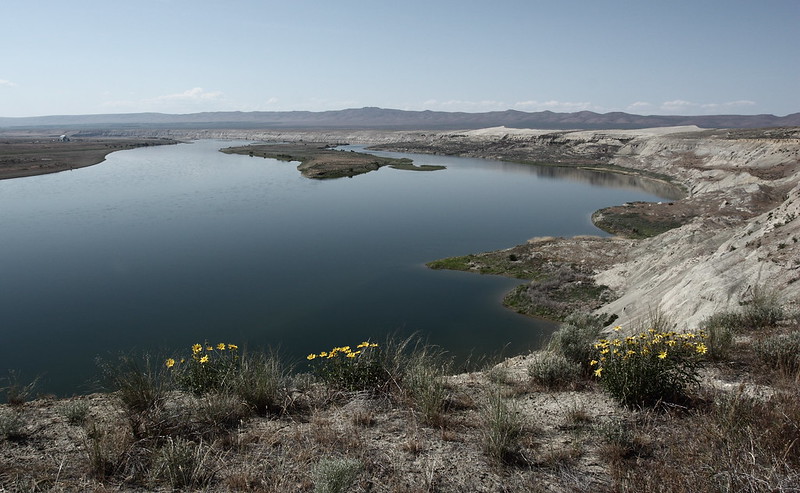
Hanford by Nicholas Blumhardt vi Flickr CC
The Department of Energy (DOE) entered into negotiations with Hecate Energy, LLC for a solar project capable of delivering up to one gigawatt of clean energy within an 8,000-acre area of DOE-owned land at the Hanford nuclear site as part of the Cleanup to Clean Energy initiative.
The Hanford site is a decommissioned nuclear production complex operated by the United States government on the Columbia River in Washington. It has also been known as Site W and the Hanford Nuclear Reservation. Established in 1943 as part of the Manhattan Project, the site was home to the Hanford Engineer Works and B Reactor, the first full-scale plutonium production reactor in the world. Plutonium manufactured at the site was used in the first atomic bomb, which was tested in the Trinity nuclear test, and in the Fat Man bomb used in the bombing of Nagasaki. For more Hanford’s history, click here.
DOE says the Cleanup to Clean Energy initiative aims to repurpose parts of DOE-owned lands to support the growth of America’s clean energy economy. The latest announcement reinforces the Biden-Harris Administration’s “whole-of-government approach to leveraging federal properties to increase the deployment of clean power through the buildout of utility-scale clean energy projects.”
Secretary of Energy Jennifer M. Granholm said, “Since the beginning of the Biden-Harris Administration, we’ve added nearly 90 gigawatts of solar capacity to the grid—enough to power roughly 13 million homes—and we’re building on this historic progress with another massive solar project,” She added that through this latest announcement, DOE is transforming thousands of acres of land at the Hanford site into a thriving center of carbon-free solar power generation.”
Hecate Energy, LLC was selected to negotiate a real estate agreement for up to 8,000 acres at Hanford that DOE is making available for the development of a gigawatt-scale solar photovoltaic system with battery storage.
The selection was made through a competitive qualifications-based process for evaluating and ranking proposals. The selection comes after public comments on a request for information in August 2023, a Cleanup to Clean Energy information day at Hanford in September 2023, and a request for qualifications issued in March 2024. DOE and Hecate Energy will negotiate a realty agreement; DOE may cancel negotiations and rescind the selection for any reason during this process.
While cleanup at the huge Hanford site could take 50 years, the solar project might be up and running in five to seven years.
In addition to supporting the Administration’s clean energy goals, this project has the potential to benefit the Hanford site, Tribal Nations, and surrounding communities, while complementing local efforts to plan for the future. DOE will complete environmental review and applicable regulatory processes, and continue to communicate and partner with industry, Tribal Nations, communities, stakeholders, regulators, and others as clean energy projects are developed on DOE land.
More information on the Cleanup to Clean Energy initiative can be found here.

 wrdforwrd